Ever found yourself wondering whether you should track words or characters for your content? You’re not alone. Whether you’re writing a tweet, crafting an essay, or optimizing meta descriptions, understanding the difference between word count and character count can save you time and frustration.
Let me break down exactly what sets these two text measurement tools apart, when to use each one, and how they can improve your writing workflow. By the end of this guide, you’ll know precisely which counter to reach for in every situation.
What’s the Real Difference Between Words and Characters?
At first glance, the distinction seems obvious. A word is a complete unit of meaning made up of letters, while a character is any single letter, number, space, or punctuation mark in your text.
But here’s where it gets interesting. When you write “Hello world!” you’ve created:
- 2 words (Hello and world)
- 12 characters with spaces (every letter, the space, and the exclamation mark)
- 11 characters without spaces (just the letters and punctuation)
This difference matters more than you might think. Social media platforms like Twitter limit posts by characters, not words. Academic papers typically require word counts, not character counts. Knowing which metric to track determines whether your content fits the requirements.
Character counting includes everything you type. Every keystroke counts—letters, numbers, spaces, punctuation marks, and even special symbols. Word counting, on the other hand, groups these characters into meaningful units separated by spaces.
What is a Word Counter?
A word counter is a text analysis tool that calculates the total number of words in your document. It works by identifying text segments separated by spaces or line breaks and counting each segment as one word.
Modern word counter tools do much more than basic counting. They help writers track their progress, meet specific requirements, and optimize content length. Whether you’re working on an essay, blog post, or manuscript, a reliable word count tool keeps you on track.
The best online word counter platforms provide instant feedback as you type. You simply paste your text or type directly into the tool, and it automatically displays your total word count. Many advanced tools also show additional metrics like sentence count, paragraph count, and reading time.
Practical benefit: Writers use word counters to ensure they meet minimum or maximum length requirements for assignments, articles, or submissions. A blog writer aiming for 2,000 words can track progress in real-time without manual counting.
What is a Character Counter?
A character counter measures every single element in your text, including letters, numbers, spaces, punctuation marks, and special symbols. This text measurement metric is essential when working with platforms that impose strict character limits.
Character counters typically offer two counting modes:
- With spaces: Includes every single keystroke
- Without spaces: Counts only letters, numbers, and punctuation
The difference between these modes matters significantly. A 280-character Twitter post with spaces might only be 240 characters without spaces. Understanding this distinction helps you maximize your message within tight restrictions.
Practical purpose: Social media managers rely on character counters to craft perfect tweets, Instagram captions, and Facebook posts that fit within platform limits. SEO specialists use them to optimize meta descriptions and title tags to exact specifications.
Key Differences Explained
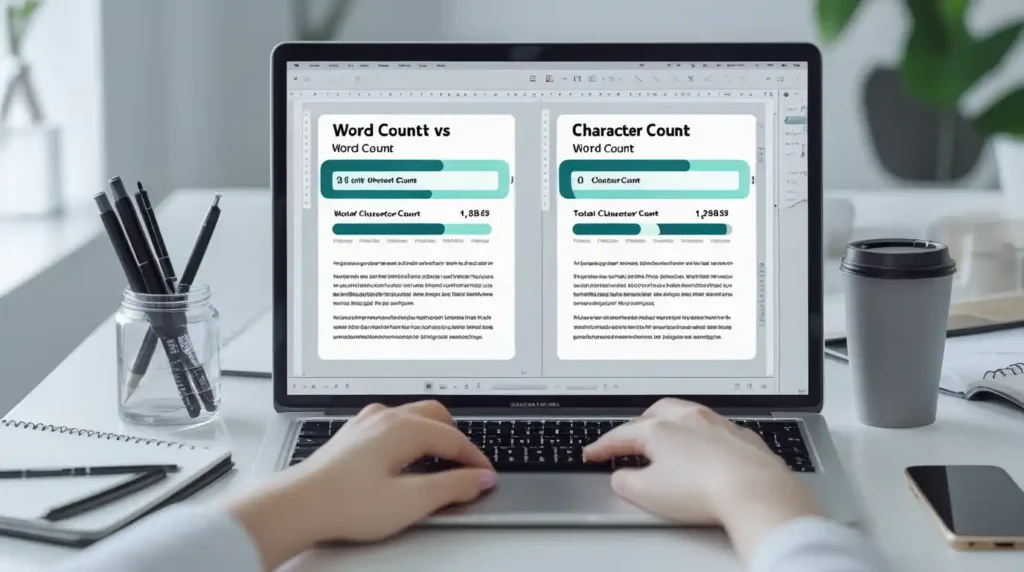
Let me show you how these two counting methods compare in real-world scenarios:
Length perception varies dramatically. A piece of text might contain 100 words but over 500 characters. Short words like “I,” “a,” and “to” count the same as longer words in word counting, but drastically less in character counting.
Platform requirements differ. Twitter enforces a character limit of 280 characters. Academic journals typically specify word counts ranging from 3,000 to 8,000 words. Google’s meta descriptions work best between 150-160 characters, while blog posts often target 1,500-2,500 words for SEO.
Precision levels change. Character count offers more granular control over text length. You can adjust your writing character by character to fit exact requirements. Word count provides a broader measure that’s easier to estimate mentally.
Use cases vary by industry. Writers and academics work in words. Digital marketers and developers work in characters. Legal professionals count words for billing. Social media experts track characters for post optimization.
When Should You Use a Word Counter?
Reach for a word counter when:
Academic writing projects require specific word counts. Universities typically set minimum and maximum word limits for essays, dissertations, and research papers. An essay word counter helps you stay within the 2,000-word limit or reach the 5,000-word minimum.
Blog post optimization needs content length tracking. SEO best practices suggest longer content tends to rank better. Most successful blog posts contain 1,500-2,500 words. A word count tool helps you hit that sweet spot without under or over-writing.
Manuscript submissions demand precise word counts. Publishers and literary agents specify word count ranges for different genres. Fiction manuscripts typically range from 70,000 to 100,000 words, while young adult novels target 50,000-80,000 words.
Professional writing rates are calculated per word. Freelance writers often charge between $0.10 and $1.00 per word depending on expertise and project complexity. An accurate word counter ensures fair pricing for both writer and client.
Content strategy planning relies on word count benchmarks. Marketing teams use average word counts to estimate project timelines and resource allocation. Knowing that a 1,000-word article takes approximately 2-3 hours helps with scheduling.
When Should You Use a Character Counter?
Switch to a character counter for:
Social media content creation with strict character limits. Twitter allows 280 characters per tweet. Instagram captions can include up to 2,200 characters, but only the first 125 display without tapping “more.” A character counter for social media posts ensures you don’t exceed limits mid-thought.
SEO meta elements that require precise character counts. Title tags should stay under 60 characters to display properly in search results. Meta descriptions work best between 150-160 characters. Going over these limits means Google truncates your carefully crafted messaging.
SMS and text messaging with character restrictions. Standard SMS messages allow 160 characters before splitting into multiple texts. International messages may have different limits. Character counting prevents unexpected message splitting and extra charges.
Online form submissions with character maximums. Job application forms often limit cover letters to 500-1,000 characters. University admission essays might specify 4,000-character personal statements. A character count calculator helps you maximize every available space.
Programming and database fields with character limits. Developers need to ensure user inputs don’t exceed database field lengths. Form validation often checks character counts. Technical documentation may reference byte sizes, which relate to character encoding.
Ad copy creation for digital platforms. Google Ads headlines allow 30 characters, descriptions get 90 characters. Facebook ad text performs best under 125 characters. LinkedIn sponsored content headlines cap at 200 characters. Character counters help marketers craft punchy, platform-compliant messages.
How to Use a Word and Character Counter (Step-by-Step)
Using modern text counter tools is refreshingly simple:
Step 1: Access a reliable online tool. Visit a trusted word counter website like ToolifyWorlds that offers both word and character counting features. No download or sign-up required for most free tools.
Step 2: Enter your text. Either type directly into the text box or copy and paste your existing content. The tool updates counts automatically as you type, providing real-time feedback.
Step 3: View your metrics instantly. Most tools display word count, character count with spaces, and character count without spaces simultaneously. Advanced tools also show sentence count, paragraph count, and average reading time.
Step 4: Adjust as needed. If you’re over or under your target count, edit your text directly in the tool. Watch the numbers update live to hit your exact requirements.
Step 5: Copy your optimized text. Once you’ve reached your goal, simply copy the edited text back to your original document or publishing platform.
Do Spaces Count as Characters?
Yes, spaces are characters—but not always counted depending on your specific needs.
When you press the spacebar, you’re creating a character in your text string. Most character counters offer both counting options because different platforms have different rules.
Character count with spaces includes every single keystroke. This is what most social media platforms and content management systems use. If Twitter says you have 280 characters available, that includes spaces.
Character count without spaces excludes whitespace between words. Some academic institutions and publishing houses prefer this method. It focuses purely on the “visible” characters you’ve typed.
Practical example: The phrase “Content is king” contains:
- 3 words
- 15 characters with spaces
- 13 characters without spaces
Understanding which counting method your platform uses prevents frustrating surprises when your content gets rejected for being too long.
How Many Characters Equal One Word?
There’s no fixed conversion rate, but the average English word contains approximately 5 to 6 characters including the space that follows it.
This rough estimate helps you make quick calculations:
- 500 words ≈ 2,500-3,000 characters with spaces
- 1,000 words ≈ 5,000-6,000 characters with spaces
- 2,000 words ≈ 10,000-12,000 characters with spaces
However, this varies significantly based on your writing style and vocabulary choices. Technical writing with longer terminology might average 7-8 characters per word. Simple, conversational content might average closer to 4-5 characters per word.
Pro tip: For accurate planning, analyze a sample of your own writing to determine your personal average. Paste 500 words into a text analyzer and divide the character count by 500 to get your specific ratio.
Why Choose ToolifyWorlds for Text Analysis?
When you need reliable text measurement tools, Toolify Worlds delivers everything in one platform:
🌍 Access 100+ tools in one place. Beyond word and character counters, you’ll find text analyzers, readability checkers, SEO tools, and conversion utilities. No more jumping between multiple websites.
🔒 Safe, secure, and private. Your text never gets stored on servers. All processing happens in your browser, ensuring complete privacy for sensitive documents or confidential content.
⚡ Instant performance and results. Real-time counting updates as you type. No loading delays or processing waits. Get immediate feedback to adjust your content on the fly.
🧠 Updated regularly with new tools. The platform evolves based on user needs. New features and tools get added consistently, keeping you equipped with the latest content optimization utilities.
💡 Built for creators, developers, and students. Whether you’re writing blog posts, coding documentation, or crafting academic papers, you’ll find tools designed specifically for your workflow.
Who Can Use These Text Counter Tools?
🧑💻 Developers and programmers need character counting for database field validation, API parameter limits, and code documentation. String length measurement ensures data fits within technical specifications without errors.
🧑🎓 Students and academics rely on word counters for essays, research papers, dissertations, and thesis work. Meeting precise word count requirements is essential for grades and academic success.
🧑💼 Content writers and bloggers use both counters for SEO optimization, content planning, and meeting client specifications. Tracking word count helps with pacing and article structure.
📱 Social media managers depend on character counters daily for crafting platform-compliant posts across Twitter, Instagram, Facebook, LinkedIn, and other networks with varying character limits.
✍️ Copywriters and marketers need character precision for ad copy, email subject lines, product descriptions, and landing page headlines where every character impacts conversion rates.
📝 Freelance writers track word counts for billing clients accurately and managing project scope. Knowing exact word counts prevents scope creep and ensures fair compensation.
Free vs Paid Word Counter Tools Comparison
Free online word counters provide basic counting features at no cost. They’re perfect for occasional use, simple projects, and quick checks. Most free tools offer real-time counting, both word and character metrics, and basic text statistics.
Paid text analysis platforms add advanced features like keyword density analysis, readability scoring, grammar checking, plagiarism detection, and detailed text metrics. Professional writers and content teams benefit from integrated suites that combine multiple analysis tools.
For most users, free word counter tools like those at Toolify Worlds provide everything needed for daily writing tasks. Upgrade to paid options only if you need enterprise features, team collaboration, or advanced content optimization analytics.
Best Practices for Content Length Optimization
Match your format to platform requirements. Always check specific guidelines before writing. Social media posts need character counting, while long-form content requires word counting.
Front-load important information. Whether working with character or word limits, put your key message first. Readers and algorithms both prioritize early content.
Edit for conciseness without sacrificing quality. If you’re over the limit, cut redundant phrases and filler words rather than removing substance. Tight writing usually performs better anyway.
Use text measurement tools during writing, not just after. Real-time counting helps you pace your content and avoid massive rewrites when you discover you’ve written 3,000 words for a 1,500-word limit.
Consider reading time alongside word count. A 2,000-word blog post takes about 8 minutes to read. Understanding this helps you match content length to audience attention spans.
Common Text Counting Mistakes to Avoid
Ignoring spaces in character counts leads to surprise overages when posting to platforms that include spaces. Always verify which counting method your platform uses.
Assuming all platforms count the same way. Twitter counts characters with spaces. Some academic systems count without spaces. Publishing houses may use word counts with specific formatting rules.
Forgetting about special characters and emojis. These count as characters and sometimes as multiple characters depending on encoding. That smiley emoji might use 2-4 character spaces.
Not accounting for formatting in word processors. Microsoft Word and Google Docs may count hyphenated words differently than online tools. Headers, footers, and footnotes might or might not be included.
Overlooking reading level and audience. Hitting a word count target matters less than providing value. A clear 800-word article beats a rambling 2,000-word piece every time.
FAQs
Q1: Is a word counter tool free to use?
Yes, most online word counter tools are completely free and don’t require any sign-up. ToolifyWorlds provides unlimited access to word and character counting tools without any cost or registration.
Q2: Can I use these tools on mobile devices?
Absolutely! Modern word and character counters work perfectly on all smartphones and tablets. They’re browser-based, so they function on any device with internet access—iOS, Android, Windows, or Mac.
Q3: Is my data safe when using online counters?
Yes, reputable tools like ToolifyWorlds process your text locally in your browser. Your content never gets stored on servers or shared with third parties, ensuring complete privacy for sensitive documents.
Q4: Do punctuation marks count as characters?
Yes, every punctuation mark—periods, commas, exclamation points, question marks, and quotation marks—counts as one character in character counting. This includes spaces between words and special symbols.
Q5: What’s better for SEO—word count or character count?
For blog content and articles, word count matters more for SEO. Search engines don’t rank based on character count. However, character count is crucial for meta descriptions (150-160 characters) and title tags (under 60 characters) which impact click-through rates.
Q6: How do I convert word count to character count?
Multiply your word count by 5 or 6 for a rough estimate. For example, 500 words equals approximately 2,500-3,000 characters with spaces. For exact counts, paste your text into a tool that shows both metrics simultaneously.
Conclusion: Choose the Right Tool for Your Writing Goals
Understanding the difference between word count and character count transforms how you approach content creation. Word counters serve academic writing, blog posts, and manuscripts where meaning and content depth matter most. Character counters excel for social media, SEO elements, and platforms with strict length restrictions.
The key is recognizing which metric your specific project requires and using the appropriate text analysis tool. With platforms like Toolify Worlds, you don’t have to choose—access both counting methods in one place, along with additional text metrics that improve your writing quality.
Start measuring your content accurately today. Whether you’re crafting your next tweet or writing a comprehensive article, the right counting tool ensures you hit your target every single time.