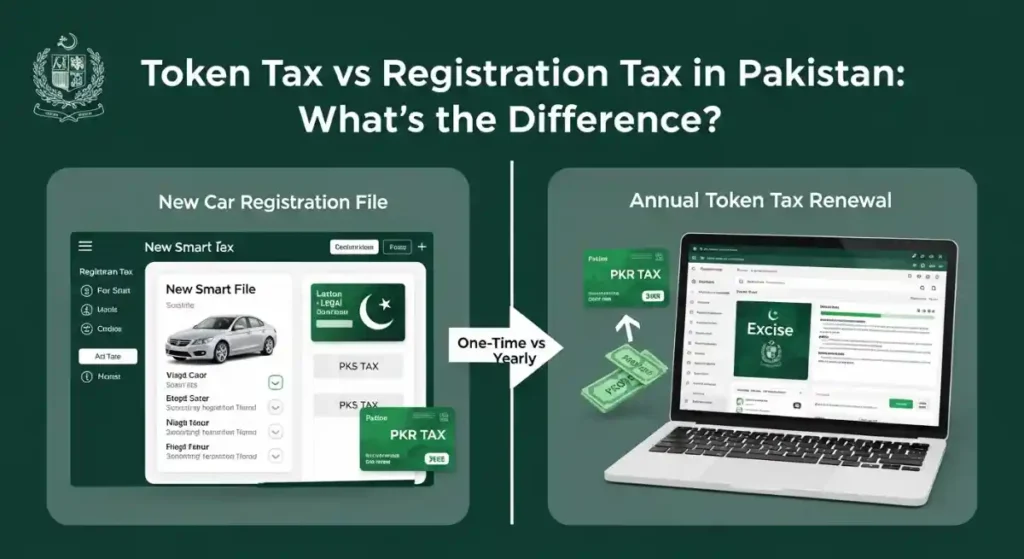
If you own a car in Pakistan, you’ve probably heard both terms — token tax and registration tax — thrown around at the excise office or by your car dealer. Most people pay these without fully understanding what they’re actually paying for, or why one comes every year while the other was a one-time thing.
This confusion costs people money. They miss deadlines, pay late fines, or walk into the excise office completely unprepared. This guide breaks down everything clearly — what each tax is, how it works, how much it costs, and what happens if you skip it.
Let’s clear this up once and for all.
What Is Registration Tax in Pakistan?
Registration tax in Pakistan is a one-time government fee you pay when you register a vehicle for the very first time. Whether you’ve bought a brand-new car from a showroom or imported one, this tax is collected before your vehicle is legally allowed on the road.
Think of it as the government’s way of officially recording that the vehicle exists and belongs to you. Once paid, your vehicle gets a registration number, a registration book, and eventually a smart card — the official proof of ownership under Pakistan’s Smart Card Registration System.
The registration tax is collected by the Excise and Taxation Department of your respective province or territory. In cities like Lahore, Karachi, and Islamabad, the process has been largely digitized with NADRA biometric verification now a part of the ownership transfer process.
How is registration tax calculated?
Registration tax in Pakistan is calculated based on several factors:
- Engine capacity (in cc)
- Vehicle type (locally assembled vs. imported)
- Vehicle value or ex-factory price
- Province or region where the vehicle is being registered
For example, a locally assembled 1000cc car will attract a significantly lower registration tax than an imported 1800cc sedan. In Punjab, the registration charges can range from a few thousand rupees for small hatchbacks to well over Rs. 100,000 for high-capacity vehicles.
This is a one-time payment — you don’t pay it again unless you’re buying a new vehicle or one is being transferred to your name for the first time through a formal re-registration.
What Is Token Tax in Pakistan?
Token tax is an annual vehicle ownership tax paid every year to keep your vehicle’s registration active and legal. It’s sometimes called the road tax or annual vehicle tax, and it’s essentially what you pay to keep driving legally on public roads in Pakistan year after year.
The name comes from the old system where vehicle owners would receive a physical “token” after paying — a sticker placed on the windscreen as proof of payment for that year.
Token tax is also collected by the Excise and Taxation Department at the provincial level, which is why rates differ between Punjab, Sindh, Islamabad, and KPK.
How is token tax calculated?
Token tax in Pakistan is primarily based on engine capacity. The bigger the engine, the higher the annual tax. Here’s a general breakdown of token tax rates for 2026 (these can vary slightly by province):
| Engine Capacity | Approximate Annual Token Tax (Punjab) |
|---|---|
| Up to 1000cc | Rs. 1,500 – Rs. 3,000 |
| 1001cc – 1300cc | Rs. 3,000 – Rs. 5,000 |
| 1301cc – 1600cc | Rs. 5,000 – Rs. 8,000 |
| 1601cc – 1800cc | Rs. 8,000 – Rs. 12,000 |
| Above 1800cc | Rs. 12,000 – Rs. 25,000+ |
Note: Exact figures vary by province and are updated annually by respective excise departments.
Want to calculate your exact token tax before heading to the excise office? You can use the Vehicle Token Tax Calculator at Toolify Worlds — it’s free, no sign-up required, and gives you instant results based on your engine size and province.
Token Tax vs Registration Tax: The Key Differences
This is where most people get confused. Let’s put it side by side so there’s zero ambiguity.
| Feature | Token Tax | Registration Tax |
|---|---|---|
| Frequency | Every year (annual) | One-time only |
| Purpose | Road usage / ownership renewal | Initial vehicle registration |
| When paid | Every year, usually by June 30 | At time of first registration |
| Calculated on | Engine capacity | Engine size + vehicle value |
| Paid to | Provincial Excise Department | Provincial Excise Department |
| Penalty for non-payment | Late fee + possible legal action | Vehicle cannot be driven legally |
| Who pays | Current registered owner | New vehicle buyer |
The simplest way to remember it: registration tax is what you pay to enter the system, token tax is what you pay to stay in the system every year.
Real Example: 1300cc Car Tax Breakdown
Let’s say you’ve just bought a new Suzuki Cultus (1000cc) in Lahore, Punjab.
At time of purchase (Registration Tax): You’ll pay a one-time registration tax based on the vehicle’s engine capacity and ex-factory price. For a 1000cc locally assembled vehicle, this typically falls in the range of Rs. 15,000 – Rs. 30,000 depending on the variant and applicable provincial rates.
Every year after that (Token Tax): You’ll pay an annual token tax of approximately Rs. 2,000 – Rs. 3,000 for a sub-1000cc vehicle in Punjab.
Now compare this to a Toyota Corolla 1800cc:
- Registration tax at the time of purchase: Rs. 60,000 – Rs. 150,000+
- Annual token tax: Rs. 10,000 – Rs. 15,000 per year
This shows you why higher engine capacity cars cost significantly more to own over time — not just in fuel, but in government taxes too.
For a full breakdown of your income or salary-related taxes, check out the Pakistan Income Tax Calculator and the Salary Tax Calculator at Toolify Worlds.
Province-Wise Variation in Token Tax
Pakistan does not have a unified national vehicle tax system. Each province administers its own rates through its Excise and Taxation Department. This means token tax in Lahore will not be the same as token tax in Karachi or Islamabad.
Punjab (Lahore, Rawalpindi, Faisalabad): Punjab uses the Online Punjab Excise system, and token tax can now be paid online through the Punjab Excise portal. Rates are engine-based and are among the most structured in the country.
Sindh (Karachi, Hyderabad): The Sindh Excise Department manages vehicle taxation in Sindh. Karachi car registration fees and token tax rates tend to be slightly different from Punjab, and online payment options have expanded in recent years.
Islamabad (Federal Capital): The Islamabad Excise Office follows federal government vehicle tax rules. Islamabad vehicle tax rates are relatively competitive compared to major provincial cities.
KPK (Peshawar, Abbottabad): KPK vehicle registration charges and token tax are managed provincially. Rates here are generally lower than Punjab and Sindh for comparable engine sizes.
The bottom line: always check with your local Excise and Taxation Department or use an online calculator to confirm the exact figures for your area.

How to Pay Token Tax Online in Pakistan
Paying token tax used to mean standing in long queues at the excise office. In 2026, most provinces have moved to digital payment systems. Here’s how it works:
Punjab:
- Visit the official Punjab Excise website or app
- Enter your vehicle registration number
- Confirm your vehicle details
- Pay via bank transfer, mobile wallet (Easypaisa/JazzCash), or debit card
- Download your digital token receipt
Sindh: The Sindh Excise online verification and payment portal allows car owners in Karachi and other cities to check and pay their vehicle tax online.
Islamabad: The Islamabad Excise Office has also integrated online vehicle tax payment options. You can verify vehicle tax status and pay directly through the system.
Documents typically required:
- Original vehicle registration book
- CNIC of the registered owner
- Previous token tax receipt
- In case of transfer: biometric NADRA verification
What Happens If You Don’t Pay Token Tax?
Skipping token tax isn’t just a minor oversight — it has real consequences.
Token tax late fee Pakistan: If you miss the annual deadline (usually June 30 of each financial year), you’ll be charged a surcharge/late fee on top of the original amount. The longer you delay, the higher the penalty accumulates.
Legal consequences:
- Traffic police can challан (fine) your vehicle if token tax is unpaid
- Your vehicle may fail the roadworthiness check
- You cannot transfer ownership of a vehicle with unpaid token tax — the buyer cannot complete the transfer process without a clean tax record
During vehicle transfer: If you’re buying a used car, always check whether token tax is up to date before paying. An unpaid token tax becomes your problem after the purchase. This is why vehicle verification through the excise department is strongly recommended before any used car transaction.
You can also explore the Late Tax Payment Penalty Calculator on Toolify Worlds to estimate what penalties might look like in your situation.
Filer vs Non-Filer: Does It Affect Vehicle Tax?
Yes — this is a detail many car buyers overlook. In Pakistan, whether you are a tax filer or non-filer affects the withholding tax you pay on vehicle purchases and transfers.
Non-filers pay higher withholding tax on vehicles above a certain value compared to active FBR tax filers. This is separate from token tax and registration tax but adds to your overall cost of vehicle ownership.
If you want to understand the full picture of how being a non-filer impacts your finances, read the guide on Filer vs Non-Filer in Pakistan at Toolify Worlds.
Documents Required for Vehicle Registration in Pakistan
When registering a new vehicle for the first time (and paying registration tax), you typically need:
- Original purchase invoice from the dealer or seller
- Copy of buyer’s CNIC (Computerized National Identity Card)
- Customs clearance documents (for imported vehicles)
- Engine and chassis number verification
- Biometric verification at NADRA for ownership transfer
- Completed registration form from the Excise Department
For imported or transferred vehicles, additional documentation such as the previous registration book and transfer deed may be required.
Are Hybrid and Electric Cars Taxed Differently?
Yes, and this is an increasingly important question as more hybrid and electric vehicles enter Pakistan’s market.
The Government of Pakistan has offered tax incentives for hybrid and electric vehicles to encourage cleaner transportation. In several cases, registration tax rates are lower for hybrids, and some provinces have offered reduced token tax for electric vehicles.
This policy is evolving, and rates may differ significantly from conventional petrol or diesel vehicles. If you own or are considering a hybrid or electric car, check with your local Excise Department or consult the latest Motor Vehicle Ordinance Pakistan updates for accurate figures.
Frequently Asked Questions (FAQs)
What is token tax in Pakistan? Token tax is an annual tax paid by vehicle owners in Pakistan to the provincial Excise and Taxation Department. It is calculated based on engine capacity and must be renewed every year to keep the vehicle’s registration legally active.
What is registration tax in Pakistan? Registration tax is a one-time fee paid when a vehicle is registered for the first time in Pakistan. It is based on the vehicle’s engine size and value and is collected by the provincial Excise Department at the time of initial registration.
Is token tax paid every year? Yes. Token tax is an annual obligation. It is due every financial year, typically by June 30. Failure to pay results in late fees and potential legal issues.
Is registration tax a one-time payment? Yes. You pay registration tax only once — when the vehicle is first registered in your name. However, transfer taxes or re-registration charges may apply in some cases when ownership changes hands.
What happens if I don’t pay token tax in Pakistan? You will face a late fee surcharge, possible traffic challans, and you won’t be able to legally transfer the vehicle’s ownership until all outstanding token taxes are cleared.
How can I check my token tax online? You can check your vehicle’s token tax status through the Punjab Excise portal, Sindh Excise website, or the Islamabad Excise system by entering your vehicle registration number.
Can I transfer a car without paying token tax? No. Outstanding token tax must be cleared before a vehicle ownership transfer can be completed. The excise department will not process the transfer if token tax is unpaid.
Is token tax the same for all cars? No. Token tax varies by engine capacity, vehicle type, and province. A 660cc vehicle pays significantly less annual token tax than a 1800cc or 2000cc vehicle.
Which tax is higher — token tax or registration tax? Registration tax is generally higher since it is a one-time charge calculated on the vehicle’s value and engine size. Token tax is lower but recurring annually.
How much is car registration tax in Pakistan? Registration tax varies widely. For a locally assembled 1000cc vehicle in Punjab, it can be Rs. 15,000 – Rs. 30,000. For larger imported vehicles, it can exceed Rs. 150,000. Always verify with your local Excise Department.
Conclusion: Know Your Vehicle Taxes, Save Money
Understanding the difference between token tax and registration tax in Pakistan is not just an academic exercise — it directly affects how much you spend on owning and operating a vehicle. Registration tax is your entry cost into the system. Token tax is your annual subscription to stay legally on the road.
Miss the token tax deadline and you’re looking at fines. Buy a used car without checking the token tax history and you inherit someone else’s problem. Know these taxes, plan for them, and you’ll avoid the unnecessary stress that catches so many Pakistani car owners off guard.
To make tax calculations easier, explore the free tools available at Toolify Worlds — including the Vehicle Token Tax Calculator, Pakistan Income Tax Calculator, and many more free tools with no login required.
Also, if you want to understand the broader tax landscape in Pakistan, don’t miss these helpful guides:
Explore free AI tools without login at Toolify Worlds and take control of your finances today.