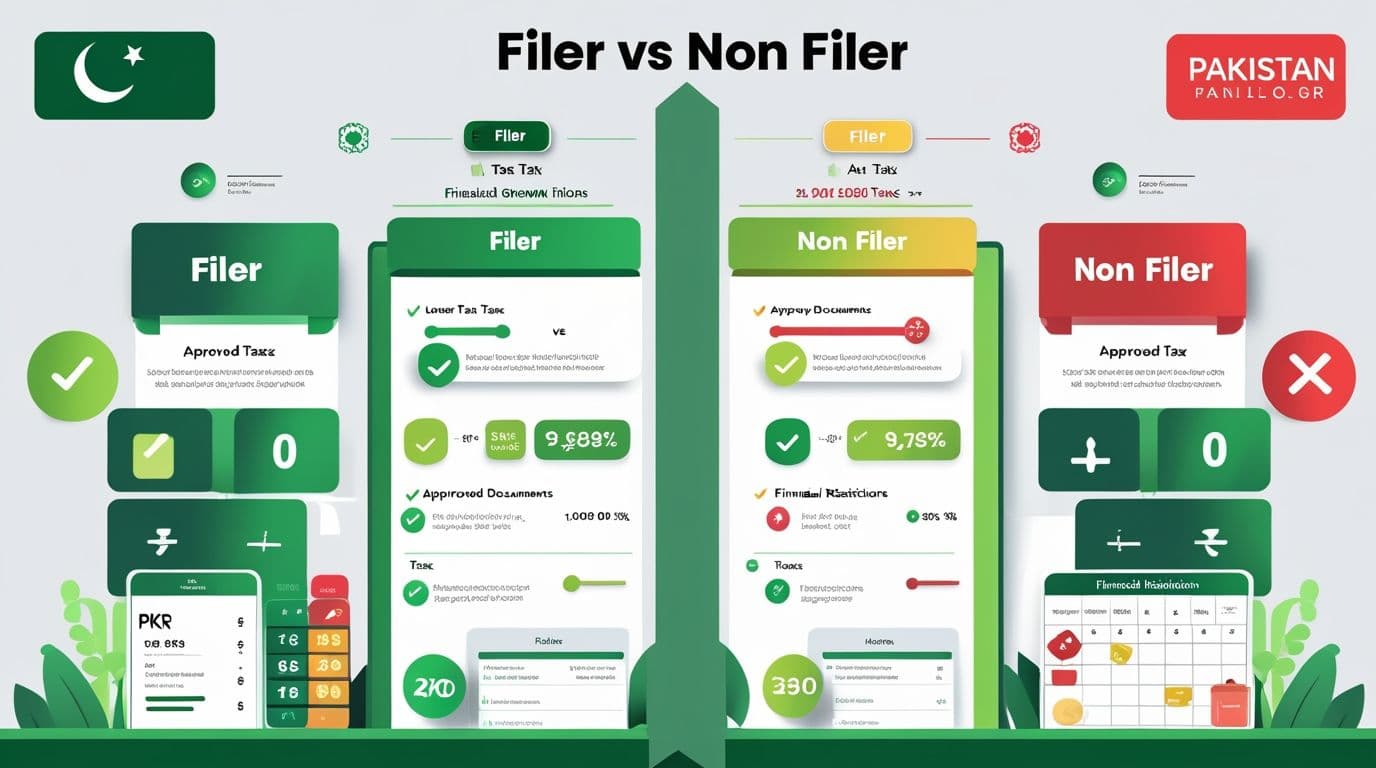
Filer vs Non Filer in Pakistan – Benefits, Tax Rates & Complete Guide
If you live in Pakistan and earn an income, you have probably heard the terms filer and non filer more times than you can count. But do you actually know what these terms mean and how they affect your daily financial life? The difference between being a filer and a non filer in Pakistan is not just about paperwork — it can cost you thousands of rupees every single year in extra taxes, higher withholding rates, and financial restrictions.
In this complete guide, we break down everything you need to know about filer vs non filer in Pakistan, including tax rates, benefits, disadvantages, and exactly how to become a filer in 2026.
What is a Filer in Pakistan?
A filer in Pakistan is a person who has filed their annual income tax return with the Federal Board of Revenue (FBR) and appears on the Active Taxpayer List (ATL). When you file your income tax return through the IRIS FBR system and your name is verified on the ATL, you are officially recognized as a tax filer.
Being on the ATL means the government considers you a compliant, financially transparent citizen. You get lower withholding tax rates on banking transactions, property purchases, vehicle registration, and more. Simply put, filers enjoy significant financial benefits that non filers do not.
To check whether someone is on the ATL, you can visit the official FBR website or use an SMS-based verification service. You can also use the Pakistan Income Tax Calculator at Toolify Worlds to quickly estimate your tax liability before filing.
What is a Non Filer in Pakistan?
A non filer in Pakistan is someone who has not filed their income tax return with FBR or whose name does not appear on the Active Taxpayer List. Even if you pay taxes through withholding at source — like on your salary or bank transactions — you are still considered a non filer if you have not submitted an annual return.
Non filers face higher tax deductions at almost every financial touchpoint. From withdrawing cash at an ATM to buying property or registering a vehicle, non filers pay significantly more in taxes compared to filers. This is Pakistan's way of encouraging tax compliance and broadening the tax base.
Key Differences Between Filer and Non Filer
The differences between a filer and a non filer in Pakistan are financial, legal, and practical. Here is a clear breakdown:
Tax on Cash Withdrawal: Filers pay 0.15% on cash withdrawals above Rs. 50,000. Non filers pay 0.60% — four times more.
Property Purchase Tax (Section 236K): Filers pay 3% advance tax on property purchase. Non filers pay 10.5% — more than three times higher.
Property Sale Tax (Section 236C): Filers pay 3% on property sale gains. Non filers pay 10%.
Vehicle Registration Tax: Filers pay lower advance tax rates when registering new vehicles. Non filers are charged at nearly double the rate depending on engine capacity.
Bank Profit / Savings Account Tax: Filers pay 15% tax on profit from savings accounts and term deposits. Non filers pay 30%.
Dividend Tax: Filers pay 15% on dividend income. Non filers pay 30%.
Prize Bond Winnings: Filers pay 15% on prize bond winnings. Non filers pay 25%.
The financial gap is enormous. For someone regularly dealing with property, banking, or investments, being a non filer can easily cost hundreds of thousands of rupees annually in extra taxes alone.
Benefits of Being a Filer in Pakistan
The benefits of being a tax filer in Pakistan go far beyond just lower tax rates. Here is why becoming a filer is one of the smartest financial decisions you can make in 2026:
Lower Withholding Tax Rates — As shown above, filers pay dramatically lower rates on banking, property, and investment transactions. This directly saves money every time you do a financial transaction.
Easier Access to Loans and Financing — Banks and financial institutions in Pakistan increasingly require ATL status for loan approvals, business financing, and credit facilities. Being a filer strengthens your financial profile.
Government Contracts and Tenders — If you run a business, government departments often require that vendors and contractors be active taxpayers on the ATL. Non filers are frequently disqualified from bidding.
Legal Protection and Documentation — Filing a return creates an official record of your income and wealth through your wealth statement. This protects you legally and helps justify large financial transactions.
Reduced Risk of Audit and Penalty — Non filers who receive income are exposed to FBR notices, audits, and penalties under the Income Tax Ordinance. Filers who stay compliant significantly reduce this risk.
International Transactions at Lower Tax — Filers enjoy lower withholding tax rates on international wire transfers and remittances compared to non filers.
Professional Credibility — For freelancers, consultants, and business owners in cities like Lahore, Karachi, and Islamabad, being a filer adds credibility and trust in professional dealings.
Want to calculate your exact savings as a filer? Try the Pakistan Business Tax Calculator at Toolify Worlds — it is free and requires no login.
Disadvantages of Non Filer Status
Staying a non filer in Pakistan is becoming increasingly costly and risky. Here are the major disadvantages:
Higher Tax Burden: Non filers pay anywhere from 2x to 4x more in withholding taxes compared to filers across almost every financial transaction.
Restricted Property Transactions: From 2022 onwards, FBR has tightened rules on property transactions for non filers. High-value property purchases attract massive advance tax penalties for non filers.
Banking Restrictions: Non filers face higher deductions on cash withdrawals, online transfers, and bank profit. Over a year, this adds up substantially for active banking users.
No Access to Tax Refunds: Filers can claim tax refunds if they have paid excess tax during the year. Non filers cannot claim any refund.
Business Limitations: Non filers cannot easily import goods, register businesses formally, or participate in government procurement.
Reputational Risk: As Pakistan's tax compliance culture matures, being known as a non filer increasingly carries social and professional stigma, especially in business circles.
Tax Rate Comparison: Filer vs Non Filer in Pakistan (2025–2026)
Here is a quick-reference comparison of the most important withholding tax rates for filers and non filers under the current FBR tax regime:
Transaction TypeFiler RateNon Filer RateCash Withdrawal (above Rs. 50,000)0.15%0.60%Property Purchase (236K)3%10.5%Property Sale (236C)3%10%Bank Profit / Savings15%30%Dividend Income15%30%Prize Bond Winnings15%25%Brokerage Commission12%15%
For a detailed breakdown of all FBR tax slabs for 2025–26, read the complete guide on FBR Tax Slabs 2025-26 at Toolify Worlds — one of the most updated resources available online.
How to Become a Filer in Pakistan
Becoming a filer in Pakistan is simpler than most people think. You do not need to hire an expensive tax consultant. Here is a step-by-step process:
Step 1 – Get Your NTN (National Tax Number) Visit the FBR IRIS portal at iris.fbr.gov.pk and register for a National Tax Number using your CNIC, phone number, and basic personal details. NTN registration is free.
Step 2 – Create Your IRIS Account After NTN registration, log in to the IRIS FBR system with your credentials. This is your main dashboard for all tax filing activities.
Step 3 – Prepare Your Income Details Gather your salary slips, bank statements, rental income records, and any other income sources. You will also need to prepare a wealth statement listing your assets.
Step 4 – File Your Income Tax Return In IRIS, navigate to the income tax return form for the relevant tax year. Fill in your income details, claim any deductions you are eligible for, and submit the return before the FBR tax return deadline (usually September 30 each year).
Step 5 – Check Your ATL Status After filing, wait for FBR to process your return and add you to the Active Taxpayer List. You can check your ATL status online at FBR's website or via SMS by sending your CNIC to 9966.
Step 6 – Pay the ATL Surcharge if Required If you missed the filing deadline, you may need to pay a surcharge to be added to the ATL. This fee varies depending on your filer category.
It is that straightforward. Millions of Pakistanis in Islamabad, Lahore, Karachi and other cities have registered as filers in recent years, and the ATL continues to grow.
For more help understanding your tax situation, check out the detailed guide on Pakistan Tax Income Calculator at Toolify Worlds.
How to Check ATL Status on FBR
Checking your filer status on FBR is quick and easy. You have two main options:
Online Method: Visit fbr.gov.pk, go to the "Online Verification" section, and enter your CNIC or NTN to check your Active Taxpayer List status instantly.
SMS Method: Send your 13-digit CNIC number to 9966 from your mobile phone. You will receive an SMS confirming whether you are on the ATL or not.
Through IRIS Portal: Log in to your IRIS FBR account and check your filing history and ATL confirmation directly from your dashboard.
If your name does not appear on the ATL even after filing, it may be due to a pending surcharge payment or processing delay. Contact your nearest FBR office for resolution.
Why Toolify Worlds is Your Best Resource for Tax Tools
Navigating Pakistan's tax system can feel overwhelming, but it does not have to be. Toolify Worlds offers a suite of free, no-login-required tools specifically designed to help Pakistanis understand and manage their taxes with ease.
Whether you need to calculate your income tax liability, estimate business taxes, or simply understand how FBR rules affect your finances, Toolify Worlds has everything in one place. Explore the full range of free AI-powered tools at Toolify Worlds — no account needed, no hassle.
Here are some tools you will find genuinely useful:
- Pakistan Income Tax Calculator — Calculate your exact income tax in seconds
- Pakistan Business Tax Calculator — Perfect for business owners and freelancers
- Image Compressor — Compress documents and images for FBR submissions
- Image Enhancer — Enhance scanned documents for clearer uploads
Toolify Worlds is built for everyday Pakistanis who want smart, fast, and free digital tools without the complexity.
FAQs About Filer vs Non Filer in Pakistan
What is a filer in Pakistan? A filer in Pakistan is a person who has submitted their annual income tax return to FBR and appears on the Active Taxpayer List (ATL). Filers enjoy significantly lower withholding tax rates on banking, property, and investment transactions.
What is a non filer in Pakistan? A non filer is someone who has not filed their income tax return with FBR or does not appear on the ATL. Non filers are subject to higher withholding tax rates and various financial restrictions under Pakistan's tax laws.
What are the main benefits of becoming a filer in Pakistan? The main benefits include lower withholding tax on cash withdrawals, property purchases and sales, bank profit, dividends, and vehicle registration. Filers also gain credibility for loans, government contracts, and business dealings.
How can I become a tax filer in Pakistan? Register on the FBR IRIS portal (iris.fbr.gov.pk), get your NTN, file your income tax return, and wait to be added to the ATL. The process is free and can be done entirely online.
What tax do non filers pay on cash withdrawals in Pakistan? Non filers pay 0.60% withholding tax on cash withdrawals above Rs. 50,000, compared to only 0.15% for filers — making it four times more expensive.
Can non filers buy property in Pakistan? Yes, non filers can technically buy property, but they pay much higher advance tax rates — up to 10.5% under Section 236K — compared to just 3% for filers. This makes property purchases significantly more expensive for non filers.
Is it mandatory to become a filer in Pakistan? Under the Income Tax Ordinance, individuals meeting certain income thresholds are legally required to file tax returns. Beyond legal requirements, the financial benefits make becoming a filer highly advisable for anyone earning a regular income.
How do I check my filer status in Pakistan? You can check your ATL status by visiting fbr.gov.pk, sending your CNIC to 9966 via SMS, or logging into your IRIS FBR account. Status updates typically reflect within a few working days of filing.
Conclusion
The difference between a filer and non filer in Pakistan is not just a bureaucratic technicality — it has a real and direct impact on how much money you keep in your pocket. From property deals worth millions to everyday banking transactions, filers consistently pay less tax and enjoy greater financial freedom.
In 2026, with FBR actively tightening enforcement and expanding the ATL, staying a non filer is riskier and more expensive than ever before. The good news is that becoming a filer is completely free, entirely online, and takes just a few hours of your time.
So if you have been putting it off, now is the time to act. Register on IRIS FBR, file your return, and start saving money from your very next financial transaction.
And while you are taking charge of your finances, do not forget to explore free AI-powered tools at Toolify Worlds — including the Pakistan Income Tax Calculator, Business Tax Calculator, and much more. No login required, no cost, just smart tools built for you.