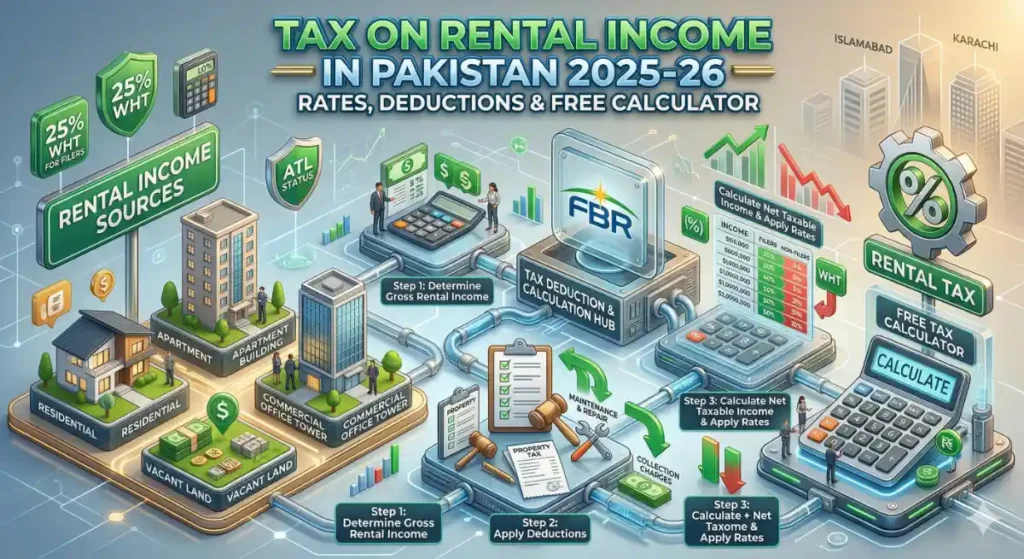
If you own a property in Pakistan and earn rent from it, the Federal Board of Revenue (FBR) considers that income taxable. It doesn’t matter whether you rent out a house in Karachi, a shop in Lahore, or an office in Islamabad — rental income tax applies to all of it. Yet most landlords in Pakistan either don’t know how much tax they owe or how to calculate it correctly.
This guide breaks down everything you need to know about Pakistan rental income tax rates, allowable deductions, withholding tax rules, filer vs non-filer differences, and how to file your return — all in plain, simple language.
Is Rental Income Taxable in Pakistan?
Yes, rental income is fully taxable in Pakistan under Section 15 of the Income Tax Ordinance 2001. Any income you receive from renting out immovable property — whether residential or commercial — falls under the head “Income from Property” and must be declared in your annual tax return filed through the FBR IRIS portal.
This applies to:
- Individual landlords renting residential or commercial property
- Companies and Association of Persons (AOP) earning rental income
- Overseas Pakistanis who own property in Pakistan and earn rent from it
Even if a tenant pays you in cash, that income is still legally required to be declared. FBR has been increasingly strict about undeclared rental income, and penalties for non-disclosure can be severe.
How is Rental Income Taxed in Pakistan? (Two Methods)
Pakistan uses two different tax mechanisms for rental income depending on who is paying you rent:
1. Withholding Tax Under Section 155 (Advance Tax)
If your tenant is a company, AOP, or any registered business entity, they are legally required to deduct withholding tax (WHT) on rent before paying you. This is governed by Section 155 of the Income Tax Ordinance 2001.
The tenant must deposit this withheld amount with FBR by the 15th of the following month. This withholding tax is not the final tax — it is treated as advance tax, which gets adjusted against your total tax liability when you file your annual return.
2. Self-Assessment for Individual Tenants
If your tenant is an individual (not a company or business), no withholding at source applies. In this case, you calculate and pay tax yourself when filing your annual income tax return.
Pakistan Rental Income Tax Rates 2025-26
Rental income is taxed under a slab-based system. The tax is calculated on your net rental income — after deductions — according to the following slabs for the tax year 2025-26:
For Filers (Active Taxpayer List — ATL):
- Up to Rs. 300,000 — 0% (tax exempt)
- Rs. 300,001 to Rs. 600,000 — 5% on the amount exceeding Rs. 300,000
- Rs. 600,001 to Rs. 2,000,000 — Rs. 15,000 + 10% on amount exceeding Rs. 600,000
- Rs. 2,000,001 to Rs. 4,000,000 — Rs. 155,000 + 15% on amount exceeding Rs. 2,000,000
- Rs. 4,000,001 to Rs. 6,000,000 — Rs. 455,000 + 20% on amount exceeding Rs. 4,000,000
- Above Rs. 6,000,000 — Rs. 855,000 + 25% on the amount exceeding Rs. 6,000,000
For Non-Filers:
Non-filers pay significantly higher withholding tax rates under Section 155. The rate for non-filers can be double the standard filer rate. This is a strong incentive to get on the Active Taxpayer List (ATL).
Want to skip the manual math? Use the free Pakistan Rental Income Tax Calculator to calculate your exact rental income tax liability in seconds — no signup required.
What is the Tax-Free Limit on Rental Income in Pakistan?
The rental income tax exemption limit for filers is Rs. 300,000 per year under the current slab structure. If your annual net rental income (after allowed deductions) is below this threshold, no tax is payable. However, you are still required to declare this income in your annual tax return.
What Deductions Are Allowed on Rental Income in Pakistan?
This is where most landlords lose money — by not claiming all the deductions they are legally entitled to. Under the Income Tax Ordinance 2001, the following allowable deductions on rental income apply:
1. Repair and Maintenance — 20% of Gross Rent FBR allows a flat 20% deduction on your gross rental income for repair, maintenance, and wear and tear of the property. You don’t need receipts — it’s a standard automatic deduction.
2. Management Expenses — 4% of Gross Rent If you pay anyone to manage your property (a property manager or agent), 4% of gross rent is deductible.
3. Insurance Premium If you have taken an insurance policy on the rental property, the annual premium is fully deductible.
4. Ground Rent Any ground rent paid to a landlord above you (for example, if you hold a leasehold property) is deductible.
5. Loan Interest / Mortgage Interest If you took a bank loan to purchase or construct the rental property, the interest paid on that loan is deductible against rental income.
6. Irrecoverable Rent If a tenant leaves without paying and the rent truly cannot be recovered, it can be claimed as a deduction in the year it becomes irrecoverable.
7. Forfeited Deposits If a tenant forfeits a security deposit, the tax treatment depends on the specific circumstances of the tenancy agreement.
Practical Example:
Suppose your gross annual rent is Rs. 1,200,000.
- Repair deduction (20%): Rs. 240,000
- Management deduction (4%): Rs. 48,000
- Net Rental Income: Rs. 912,000
- Tax on Rs. 912,000 as a filer: Rs. 15,000 + 10% of Rs. 312,000 = Rs. 46,200
Without knowing these deductions, many landlords pay tax on the full Rs. 1,200,000 — overpaying by tens of thousands of rupees every year.
Filer vs Non-Filer: What’s the Difference for Rental Tax?
Being on the FBR Active Taxpayer List (ATL) directly affects how much rental income tax you pay. Non-filers face:
- Higher withholding tax rates under Section 155
- No ability to claim deductions properly
- Risk of tax notices and FBR audits
- Potential penalties for undeclared income
Becoming a filer is straightforward. You register on the FBR IRIS portal, get your National Tax Number (NTN) using your CNIC, and file an annual tax return. Once filed, your name appears on the ATL within days.
See exactly how much more a non-filer pays compared to a filer using the free Filer vs Non-Filer Tax Comparison Calculator — and decide for yourself whether staying off the ATL is worth the cost.
Rental Income Tax on Commercial Property Pakistan
Commercial property — shops, offices, plazas, warehouses — follows the same slab-based structure but typically generates higher rental income, pushing landlords into higher tax brackets. If your commercial tenant is a registered company, they will automatically deduct WHT under Section 155 before paying your monthly rent.
Tax on shop rent in Pakistan and tax on office rent follows the same gross-to-net deduction method described above. The deductions (20% repairs, 4% management) still apply and can significantly reduce your taxable income.
If you own commercial property and need to calculate your exact tax exposure, use the Pakistan Business Tax Calculator built specifically for business and commercial income scenarios.
How to Calculate Rental Income Tax in Pakistan (Step-by-Step)
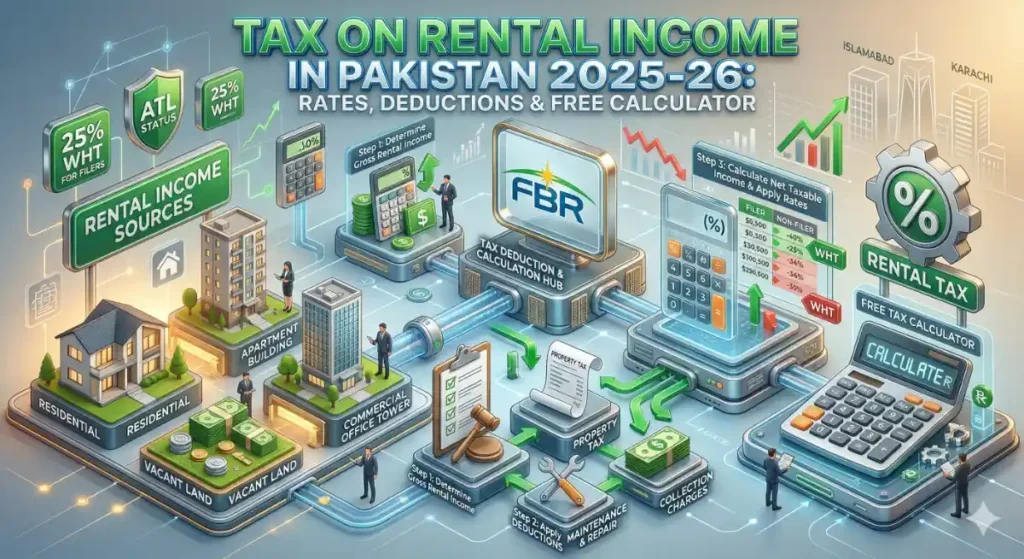
Here is the exact formula to calculate your rental income tax:
- Calculate your Gross Annual Rent received
- Subtract 20% for repairs and maintenance
- Subtract 4% for management expenses
- Subtract any insurance premiums, ground rent, or loan interest paid
- The result is your Net Rental Income
- Apply the slab rate based on your ATL status
- The tax calculated is your annual rental income tax liability
For a fast and accurate result without doing this manually, the Free Online Rental Income Tax Calculator for Pakistan does all the math instantly — just enter your rent amount and it handles the rest.
How to File Rental Income Tax Return in Pakistan
Filing your rental income tax return is done through the FBR IRIS portal (iris.fbr.gov.pk). Here is the process:
- Log in to IRIS using your NTN and password
- Go to “Declaration” and select the relevant tax year return
- Under “Income from Property,” enter your gross rent received
- Enter all applicable deductions
- The system calculates net income and tax liability automatically
- Pay any due tax through online banking or an authorized bank
- Submit the return before the due date (typically September 30 each year)
If you miss the deadline, penalties for late filing apply — initially Rs. 1,000 per day for individuals. Use the Late Tax Payment Penalty Calculator to find out exactly how much your delay is costing you.
Tax on Rental Income for Overseas Pakistanis
If you are a Pakistani living abroad and receiving rent from property inside Pakistan, your rental income is still taxable in Pakistan under domestic tax law. Your tenant (if a company) must deduct WHT under Section 155. You or your authorized tax representative must file an annual return in Pakistan declaring this income.
Double taxation treaties exist between Pakistan and several countries, which may allow you to claim credit for taxes paid in Pakistan against your foreign tax liability. If you also earn freelance or remote income alongside rental income, the Pakistan Freelance Tax Calculator can help you calculate your combined tax position accurately.
What Happens If You Don’t Pay Rental Income Tax in Pakistan?
FBR has the authority to issue tax notices, conduct audits, and impose penalties on landlords who fail to declare rental income. Consequences of tax evasion on rental income include:
- A tax demand notice with interest on unpaid tax
- Penalty up to 25% of the tax payable
- Prosecution in serious cases of deliberate evasion
- Being flagged as a non-filer with restricted banking and property transactions
FBR has been cross-referencing property registration data, utility connections, and CNIC records to identify undeclared landlords. The risk of getting caught is rising every year.
Location-Specific Notes: Karachi, Lahore, Islamabad & Other Cities
Federal income tax on rental income applies uniformly across all of Pakistan — whether your property is in Karachi, Lahore, Islamabad, Rawalpindi, Peshawar, Faisalabad, Multan, or Quetta. The FBR rates do not change by city.
However, provincial taxes also apply separately:
- Sindh: Urban Immovable Property Tax is levied by the Sindh government on properties in Karachi and other urban Sindh areas.
- Punjab: Punjab levies its own Urban Immovable Property Tax through Excise and Taxation Punjab, applicable in Lahore, Faisalabad, Rawalpindi, and other cities.
- KPK and Balochistan: Similar provincial property taxes apply through respective Excise departments.
DHA Karachi, DHA Lahore, and Bahria Town properties follow the same federal income tax rules but may have separate society-level charges unrelated to FBR.
Useful Tools & Related Guides on Toolify Worlds
Toolify Worlds offers completely free Pakistan tax tools — no login, no signup required:
- Pakistan Income Tax Calculator — Calculate Your Rental Tax Instantly
- Pakistan Business Tax Calculator — For AOP and Commercial Landlords
- Pakistan Freelance Tax Calculator — For Overseas & Freelance Income
- Filer vs Non-Filer Tax Comparison Tool — See How Much You Save by Filing
- Late Tax Payment Penalty Calculator — Know Your Penalty Before FBR Does
Related blog guides to deepen your knowledge:
- FBR Active Taxpayer List 2026 — How to Check and Join ATL
- Filer vs Non-Filer in Pakistan — Complete Tax Difference Guide
- Withholding Tax Pakistan 2025-26 — Full Rates and Rules
- FBR Tax Slabs 2025-26 — Updated Income Tax Slabs for All Categories
- Super Tax Pakistan 2026 — Who Pays It and How Much
- Pakistan Income Tax Complete Guide 2026
- Master Pakistan Income Tax 2026 — Step by Step Guide
For official ordinance updates, circulars, and FBR notifications, always refer to the Federal Board of Revenue Official Website as the authoritative external source.
Frequently Asked Questions (FAQs)
Is rental income taxable in Pakistan? Yes. Rental income is taxable under Section 15 of the Income Tax Ordinance 2001. All landlords — individual, corporate, or AOP — must declare rental income in their annual tax return filed through the FBR IRIS portal.
What is the tax rate on rental income in Pakistan? For filers, rental income up to Rs. 300,000 annually is exempt. Above that, slab rates ranging from 5% to 25% apply on net rental income for the tax year 2025-26. Non-filers pay higher rates under Section 155.
What deductions are allowed on rental income in Pakistan? You can deduct 20% of gross rent for repairs and maintenance, 4% for management expenses, insurance premiums, ground rent paid, and mortgage interest — all before calculating your taxable net rental income.
What is withholding tax on rent in Pakistan? Under Section 155 of the Income Tax Ordinance, any tenant who is a company or registered business must deduct tax at source before paying rent and deposit it with FBR by the 15th of the following month.
How much tax does a non-filer pay on rental income? Non-filers typically pay double the withholding tax rate compared to filers under Section 155. Use the Filer vs Non-Filer Tax Comparison Calculator to see the exact difference for your rental amount.
What happens if I don’t declare rental income in Pakistan? FBR can issue a tax demand notice, impose penalties up to 25% of unpaid tax, and conduct a full audit. Persistent non-disclosure may lead to prosecution under the Income Tax Ordinance 2001.
Can I claim insurance premium on rental property in Pakistan? Yes. Any insurance premium paid on the rental property is a fully deductible expense against your gross rental income under the Income Tax Ordinance 2001.
What is Section 155 of the Income Tax Ordinance? Section 155 governs withholding tax on property income. It requires tenants who are companies or AOPs to deduct advance tax before paying rent to the landlord and deposit it with FBR by the 15th of the following month.
Conclusion
Tax on rental income in Pakistan is not optional — and with FBR tightening enforcement through the IRIS portal, property registration databases, and CNIC cross-checks, undeclared rental income is harder to hide than ever before. The good news is that with the right deductions — 20% for repairs, 4% for management, plus insurance and loan interest — your actual tax liability can be far lower than you expect.
The smartest step any Pakistani landlord can take right now is to become an active filer, claim every deduction you are entitled to, and file your annual return on time.
Start by calculating your exact liability today — free, instant, no login required:
Calculate Your Pakistan Rental Income Tax Free — Toolify Worlds