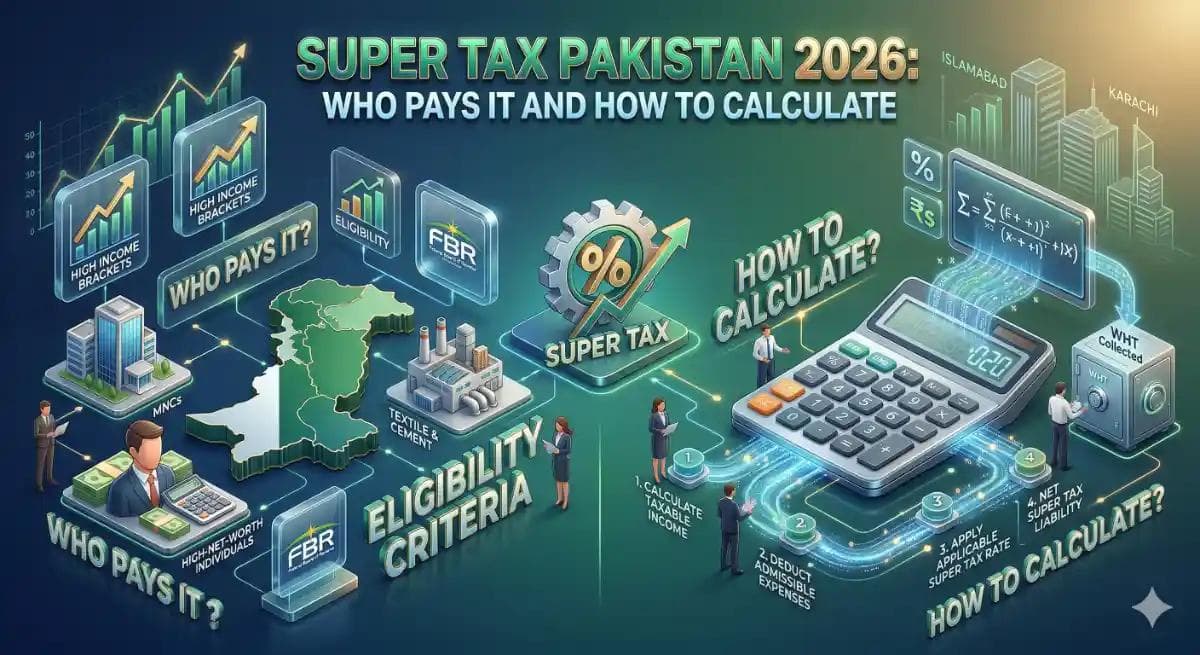
Super Tax Pakistan 2026: Who Pays It and How to Calculate
Super Tax in Pakistan is an additional levy imposed on high-income individuals, companies, and banking institutions — on top of regular income tax — under Section 4B and Section 4C of the Income Tax Ordinance 2001. For Tax Year 2026, any person or entity with an annual income exceeding PKR 150 million is liable to pay super tax at graduated rates ranging from 1% to 10%, depending on income level and sector. Whether you run a large corporation in Karachi, manage a banking company in Lahore, or lead a profitable enterprise in Islamabad — if your taxable income crosses the threshold, this tax applies to you.
And here's the big news: in January 2026, the Federal Constitutional Court (FCC) upheld super tax as fully constitutional, settling over 2,200 pending cases and securing an estimated Rs 310 billion in unpaid revenues. Meanwhile, PM Shehbaz Sharif has also approved a proposal to potentially abolish super tax — pending IMF approval. This guide breaks everything down: who pays, exact slabs, step-by-step calculation, and what the latest developments mean for you.
What Is Super Tax in Pakistan?
Super tax is essentially a surtax on profits — a progressive corporate tax that sits on top of your regular income tax liability. It is not a replacement for income tax; it's an additional burden imposed on those who earn significantly above average.
The tax was first introduced through Finance Act 2015 (Section 4B) to fund the rehabilitation of internally displaced persons. It was significantly expanded in Finance Act 2022 through Section 4C, which lowered the threshold from Rs 500 million to Rs 150 million and introduced a broader slab structure covering virtually all high-earning sectors.
Think of it this way: a large cement company in Punjab paying 29% corporate tax on its profits still has to calculate super tax on top of that — using separate slab rates based on how much income it earned that year.
The Federal Board of Revenue (FBR) — Pakistan's primary tax authority — is responsible for collection, enforcement, and filing procedures related to super tax through the IRIS portal at iris.fbr.gov.pk.
Who Pays Super Tax in Pakistan 2026?
This is the most important question — and the answer is more specific than most people realise.
Applicability Threshold
Super tax under Section 4C applies to any person — whether an individual, Association of Persons (AOP), or company — whose taxable income exceeds PKR 150 million in a given tax year.
The following categories are directly liable:
- Banking companies earning more than PKR 300 million (at a flat 10% rate)
- Large corporations in all sectors (cement, steel, telecom, oil & gas, fertiliser, textile, pharma, automobile, insurance)
- High-income individuals and AOPs earning above Rs 150 million
- Multinational companies operating in Pakistan with qualifying income
- All companies assessed under the Fourth, Fifth, and Seventh Schedules of the Income Tax Ordinance, if income exceeds the threshold
Who Is Exempt?
- Companies or individuals with annual income below PKR 150 million are not liable under Section 4C
- The petroleum exploration sector received partial relief from the FCC ruling, since enforcing super tax in that sector risked breaching contractual obligations and international arbitration
- SMEs (with business turnover under PKR 250 million, engaged in manufacturing) are classified separately and may fall outside the super tax bracket
Super Tax Slabs Pakistan 2026: Complete Rate Table
The following slab structure applies under Division IIB, Part I, First Schedule of the Income Tax Ordinance 2001, as updated through Finance Act 2023 and Finance Act 2025:
Annual Taxable Income (PKR)Super Tax RateUp to 150 million0% (Not liable)150 million – 200 million1%200 million – 250 million2%250 million – 300 million3%300 million – 350 million4%350 million – 400 million6%400 million – 500 million8%Above 500 million10%Banking companies (income > 300 million)10% (flat)
Important Update (Finance Act 2025): The super tax rate for income slabs between PKR 250 million and PKR 500 million was reduced by 0.5% through Finance Act 2025 — a modest relief for mid-tier corporations before the FCC ruling locked in the broader structure.
How to Calculate Super Tax in Pakistan — Step by Step
Calculating super tax is straightforward once you understand the slab structure. Unlike regular income tax, which uses a cumulative progressive formula, super tax in Pakistan applies the applicable rate to the entire taxable income (not just the portion within that slab). Here's a practical walkthrough:
Step 1: Determine Your Annual Taxable Income
Start with your total income from all sources and subtract allowable deductions, losses, and exemptions as per the Income Tax Ordinance 2001. This is your net taxable income for the year.
Example: A construction company in Karachi has a net taxable income of PKR 380 million for Tax Year 2026.
Step 2: Check the Super Tax Threshold
Is your taxable income above PKR 150 million? If yes, super tax applies. In our example, PKR 380 million clearly exceeds the threshold.
Step 3: Identify the Applicable Slab Rate
Using the table above, PKR 380 million falls in the PKR 350 million – 400 million slab. The applicable rate is 6%.
Step 4: Apply the Rate to Total Taxable Income
Super tax = 6% × PKR 380,000,000 = PKR 22,800,000
Note: This is in addition to regular corporate income tax. Both liabilities must be paid separately.
Step 5: File and Pay Through FBR IRIS Portal
Log in to IRIS at iris.fbr.gov.pk, complete your income tax return, and include super tax liability on the designated field. Payment is made via the FBR e-payment (PSID) system.
Banking Company Calculation Example
A banking company based in Lahore earns PKR 700 million in net income for Tax Year 2026.
- Income exceeds PKR 300 million → flat 10% super tax applies
- Super tax = 10% × 700,000,000 = PKR 70,000,000
- This is in addition to the banking company's corporate income tax at applicable rates
Super Tax vs. Income Tax: Key Differences
Many taxpayers confuse super tax with regular income tax. Here's a clear comparison:
FeatureIncome TaxSuper TaxLegal BasisSection 4, ITO 2001Sections 4B & 4C, ITO 2001Applicable ToAll taxpayers above thresholdHigh-income only (>Rs 150M)RateProgressive (up to 35%)1% to 10% based on slabPurposeGeneral government revenueAdditional fiscal levy on high earnersDeductible?No, from super tax calculationNo, not a deductible business expenseAdministered ByFBR via IRIS portalFBR via IRIS portal
For a deeper understanding of how income tax slabs work separately, see our guide: FBR Tax Slabs 2025-26 – Complete Breakdown.
Super Tax and Withholding Tax: Are They Connected?
They are related but distinct mechanisms. While super tax is declared and paid annually through your income tax return, withholding tax operates throughout the year as an advance collection mechanism. Companies liable for super tax must also ensure their withholding tax obligations are met under Section 153 and related provisions.
If you want to understand withholding tax rates and obligations in detail, our blog Withholding Tax Pakistan 2025-26: Everything You Need to Know covers it comprehensively.
Sector-Specific Super Tax: Which Industries Pay What?
Banking Sector — 10% Flat Rate
Banking companies with income above PKR 300 million pay 10% super tax — the highest rate. This has been a major point of contention for banks in Karachi and Lahore, where most large financial institutions are headquartered.
Oil & Gas / Petroleum Sector — Special Relief
The FCC ruling in January 2026 granted the petroleum exploration sector specific relief, acknowledging that enforcing super tax where contracts exist risked triggering international arbitration. This is the only sector that received carve-out treatment.
Telecom Companies — Standard Slabs Apply
Major telecom companies in Karachi and Islamabad are subject to standard super tax slabs under Section 4C based on their annual taxable income.
Cement, Steel, Fertiliser, Textile — Standard Slabs Apply
All large industrial companies across Punjab, Sindh, and KPK are subject to the graduated slab rates from 1% to 10% depending on income level.
Automobile & Pharmaceutical Companies — Standard Slabs
Car manufacturers and pharmaceutical firms with income exceeding Rs 150 million fall within the standard super tax structure.
Super Tax Filer vs. Non-Filer in Pakistan
Being on the FBR Active Taxpayer List (ATL) matters enormously when it comes to super tax compliance. Companies and individuals who are active filers face lower withholding tax rates across transactions — but super tax itself applies based on income levels regardless of filer status.
Non-compliance with super tax, however, carries serious consequences: penalties, interest charges, and enforcement actions by the FBR. Check your ATL status using the guide: FBR Active Taxpayer List 2026 – How to Check Your Status.
To calculate your exact tax liability including super tax, use the free tool at Toolify Worlds: Pakistan Income Tax Calculator and Pakistan Business Tax Calculator.
The FCC Ruling: Super Tax Is Constitutional — January 2026
This is the most significant legal development in Pakistan's tax history in years.
On January 27, 2026, the Federal Constitutional Court (FCC) — a three-member bench headed by Chief Justice Amin-ud-Din Khan — dismissed all petitions challenging the super tax and upheld Sections 4B and 4C of the Income Tax Ordinance 2001 as fully constitutional.
Key points from the ruling:
- The FCC ruled that parliament has complete authority to impose, abolish, or alter taxes through a Finance Act as part of a Money Bill under Article 73(2)(a) of the Constitution
- The court declared that super tax is not discriminatory — its classification is income-based and bears rational nexus with the objective
- High Courts that had struck down Section 4C were declared to have committed "judicial overreach, violating the doctrine of separation of powers"
- Section 4B applies from tax year 2015 onwards; Section 4C applies from tax year 2022 onwards
- The ruling settled over 2,200 pending cases and is expected to result in recovery of approximately Rs 310 billion in previously stayed tax revenues
- The only sector receiving relief was petroleum exploration, where enforcement risked breaching contractual obligations
This ruling, widely reported by Dawn, Geo, The Express Tribune, and The Nation, has effectively ended years of legal uncertainty around super tax — at least on the constitutional front.
PM Shehbaz Approves Plan to Abolish Super Tax — March 2026
Just weeks after the FCC ruling locked in the constitutionality of super tax, Prime Minister Shehbaz Sharif approved a proposal to abolish the super tax — but with a significant condition attached.
According to reports from The Express Tribune and Pakistan Today (March 2026), the PM chaired a meeting with senior officials from the Ministry of Finance and FBR where the proposal was endorsed. The government also plans to reduce the maximum income tax rate for the highest salaried bracket by 5% (to 30%).
However, the government cannot implement these changes unilaterally. IMF approval is required before any changes take effect — given Pakistan's ongoing program with the International Monetary Fund. During ongoing IMF discussions, the FBR had already been flagged for underperformance, having sought a reduction in its tax collection target.
What this means for taxpayers:
- Super tax remains fully operative for Tax Year 2026
- Any abolishment would be announced in the Federal Budget 2026-27 (expected June 2026)
- The change would be subject to IMF consent and could be phased rather than immediate
- Until an official notification from FBR, all liable entities must calculate and pay super tax as normal
How to File Super Tax with FBR — Practical Steps
Super tax is not filed separately. It is declared as part of your annual income tax return through the FBR IRIS portal. Here's the practical process:
- Register on IRIS at iris.fbr.gov.pk if not already registered (mandatory for all taxpayers)
- Log in to your taxpayer account using your NTN and password
- Open the Income Tax Return form for Tax Year 2026
- Fill in your taxable income, deductions, and source-wise income details
- The super tax field (under Section 4C) will auto-calculate based on entered income — verify the slab and rate
- Generate your PSID (Payment Slip ID) for tax payment
- Pay through any authorised bank or via FBR e-payment at epayment.fbr.gov.pk
- Submit your return before the deadline — typically September 30, 2026 for Tax Year 2026
For companies that have previously obtained court stay orders against super tax payment, the FCC ruling now requires them to pay all accumulated dues. FBR is expected to issue formal recovery notices to these entities.
Super Tax and Bank Profit Tax in Pakistan 2026
If your company earns income from bank deposits — such as profit on savings accounts or term deposits — understanding how these are taxed alongside super tax is important. Our detailed guide on How to Calculate Tax on Bank Profit in Pakistan explains the withholding tax mechanism on profit income and how it interacts with your overall tax liability.
Use a Free Super Tax Calculator
Manually calculating super tax across different income levels and sectors can be time-consuming. Toolify Worlds offers free, no-login tax tools designed specifically for Pakistani taxpayers:
- 🧮 Pakistan Income Tax Calculator — Calculate your full income tax liability including salaried and business income
- 🏢 Pakistan Business Tax Calculator — For companies and AOPs with complex income structures
- 💰 Late Tax Payment Penalty Calculator — Estimate penalties if you've missed deadlines
These tools are completely free and require no signup. Explore all free tax tools at Toolify Worlds.
Frequently Asked Questions: Super Tax Pakistan 2026
What is super tax in Pakistan?
Super tax is an additional levy imposed on high-income individuals, AOPs, and companies under Sections 4B and 4C of the Income Tax Ordinance 2001. It applies on top of regular income tax and is collected by FBR. The rates range from 1% to 10% depending on income level and sector.
Who is required to pay super tax in Pakistan 2026?
Any person — individual, AOP, or company — with annual taxable income exceeding PKR 150 million is liable for super tax under Section 4C. Banking companies with income above PKR 300 million face a flat 10% rate. All sectors except petroleum exploration (which received partial FCC relief) are subject to the standard slab structure.
What is the minimum income to be liable for super tax in Pakistan?
The minimum threshold is PKR 150 million in annual taxable income. Anyone earning below this amount is not subject to super tax under Section 4C, even if liable for regular income tax.
What are the super tax slabs in Pakistan 2026?
Super tax slabs range from 1% (on income Rs 150M–Rs 200M) to 10% (on income above Rs 500M). Banking companies earning above Rs 300 million pay a flat 10%. The Finance Act 2025 reduced rates by 0.5% for income slabs between Rs 250M and Rs 500M.
Is super tax permanent or temporary in Pakistan?
Super tax was originally introduced as a temporary measure for displaced persons rehabilitation (2015). However, it has been made a regular annual levy. The Federal Constitutional Court confirmed in January 2026 that it is constitutionally valid. While PM Shehbaz has approved a proposal to abolish it, no official change has been enacted as of March 2026.
Has super tax been abolished in Pakistan 2026?
No. As of March 2026, super tax has not been abolished. PM Shehbaz Sharif approved a proposal to seek IMF consent for abolishment, but it remains pending. The FCC ruling in January 2026 upheld its constitutionality. It continues to apply for Tax Year 2026.
Is super tax deductible as a business expense in Pakistan?
No. Super tax is not an allowable deduction under income tax law. It is a separate tax liability and cannot be claimed as a business expense to reduce taxable income.
What is Section 4C of the Income Tax Ordinance Pakistan?
Section 4C was introduced through Finance Act 2022 and imposes an additional super tax on persons with income above Rs 150 million. It prescribes graduated rates from 1% to 10% under Division IIB of Part I of the First Schedule. The FCC declared Section 4C constitutionally valid in January 2026 and applicable from Tax Year 2022 onwards.
What happened with the super tax court case in Pakistan?
The Federal Constitutional Court (FCC), in its ruling dated January 27, 2026, dismissed all petitions challenging super tax and upheld both Section 4B and Section 4C as constitutional. The ruling resolved 2,200+ pending cases and is expected to unlock recovery of approximately Rs 310 billion in stayed taxes.
Is super tax applicable on individuals in Pakistan 2026?
Yes. Super tax under Section 4C is not limited to companies. Individuals and AOPs with taxable income exceeding PKR 150 million are also liable, subject to the same graduated slab rates as other non-banking entities.
Conclusion: What You Need to Know Right Now
Super Tax Pakistan 2026 is real, it's constitutional, and it's fully enforceable — the FCC has made that absolutely clear. If your business or personal income exceeds PKR 150 million, you must calculate, declare, and pay super tax through FBR IRIS as part of your annual tax return.
Here's the one-line summary: Super tax rates for Tax Year 2026 range from 1% to 10%, apply to all sectors with taxable income above Rs 150 million, and are filed through the FBR IRIS portal alongside your regular income tax return.
Yes, there's talk of abolishment — PM Shehbaz has approved the proposal. But until IMF consent is obtained and the Finance Act 2026-27 officially removes it, the levy stands. Proactive compliance now avoids penalties, interest, and enforcement actions later.
For comprehensive tax planning, use our free tools and explore our full tax resource library:
- 📊 Pakistan Income Tax Calculator
- 📚 Master Pakistan Income Tax 2026 – Full Guide
- 📋 Filer vs Non-Filer in Pakistan: What's the Difference?
- 🔍 FBR Active Taxpayer List 2026
Explore All Free Tax Tools — No Login Required at Toolify Worlds