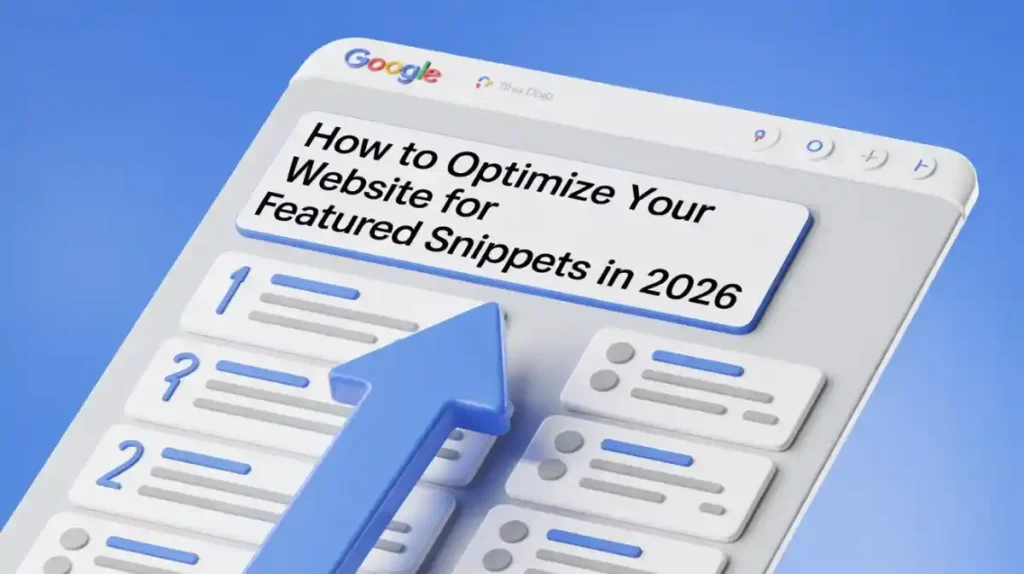
If you’ve ever searched something on Google and seen a box at the very top of the results — showing a direct answer before any website links — that’s a featured snippet. And in 2026, getting your content into that box is one of the most powerful things you can do for your website’s visibility.
Featured snippets, also called position zero, sit above all organic results. They get your content seen first, even if you’re not technically ranking #1. With Google’s AI overviews now changing the search landscape, knowing how to optimize your website for featured snippets in 2026 is no longer optional — it’s essential.
This guide walks you through everything: what featured snippets are, why they matter, and a step-by-step featured snippet SEO strategy that actually works this year.
What Are Featured Snippets and Why Do They Matter in 2026?
A featured snippet is a selected search result that Google displays in a special box at the top of the SERP (Search Engine Results Page). It pulls a short, direct answer from a webpage and shows it alongside the page title and URL.
There are four main types of featured snippets:
- Paragraph snippets — a short block of text answering a question directly
- List snippets — numbered or bulleted lists (great for “how to” content)
- Table snippets — data presented in a table format
- Video snippets — a YouTube or embedded video clip answering a query
In 2026, featured snippets matter more than ever for three big reasons. First, they dramatically increase your search visibility — even if you rank on page two. Second, Google’s AI overviews frequently pull content directly from featured snippet sources. Third, voice search assistants like Google Assistant and Alexa read featured snippet answers aloud. If you want to rank in AI overviews and be cited by AI chatbots, the featured snippet box is your gateway.
According to data from SEMrush and Ahrefs, pages that win featured snippets see a click-through rate increase of anywhere from 20% to over 500%, depending on the query. The answer box isn’t just a vanity metric — it drives real traffic.
How Does Google Choose Featured Snippet Content?
Understanding how Google selects content for the answer box is the foundation of any good featured snippet SEO strategy.
Google looks for content that:
- Directly answers a specific search query
- Is structured in a clear, easy-to-extract format
- Comes from a page that already ranks on page one for that keyword
- Demonstrates topical authority and E-E-A-T (Experience, Expertise, Authoritativeness, Trustworthiness)
- Uses semantic HTML headings (H2, H3) that signal content structure
One important thing most people don’t realize: you generally need to already be ranking in the top 10 results to win a featured snippet. Google doesn’t pull from page two. So your first job is to rank — then optimize for the snippet.
Google also uses passage indexing, which means it can extract and rank individual sections of your page. This is why structuring your content with clear H2 and H3 subheadings that mirror search queries is so critical in 2026.
Featured Snippet Ranking Factors in 2026
Before jumping into tactics, let’s be clear about what actually moves the needle. The main featured snippet ranking factors in 2026 are:
Content format and structure — Is your answer clearly formatted for extraction? Paragraph, list, or table — match the format to the query type.
Search intent alignment — Does your content actually answer what the user is searching for? Informational queries (“what is,” “how to,” “why does”) are the most common featured snippet triggers.
Word count of the answer — The ideal featured snippet answer is between 40 and 60 words. Longer than that and Google won’t pull it cleanly. Shorter and it may not contain enough value.
Semantic relevance — Google’s NLP algorithms look for co-occurrence keywords, entity-based signals, and topical authority. Your content needs to cover the topic deeply, not just target a single keyword.
Schema markup — While schema markup doesn’t directly cause featured snippets, using FAQ structured data, HowTo schema, and Article schema sends strong relevance signals that improve your chances. You can generate FAQ schema instantly using the FAQ Schema Generator tool at Toolify Worlds.
Page speed and Core Web Vitals — A slow website can hurt your ability to win and keep featured snippet positions. Check your technical SEO health with the Technical SEO Checklist guide and if you have Core Web Vitals issues, read the Fix Core Web Vitals 2026 guide.
Step-by-Step: How to Optimize Your Website for Featured Snippets in 2026
Step 1 — Find Featured Snippet Opportunities
Not every keyword triggers a featured snippet. Your first step is to identify queries that already show a snippet in Google results — because that means Google has decided this query type deserves a direct answer.
Use tools like SEMrush, Ahrefs, or Google Search Console to find:
- Keywords you currently rank in positions 2 through 10 for (prime candidates)
- Question-based queries starting with what, how, why, when, who, or which
- Keywords that already show a featured snippet from a competitor
Long-tail informational keywords are your best bet. Phrases like “how to optimize website for featured snippets in 2026” or “what is the best word count for featured snippets” have clear informational intent and are exactly what Google builds answer boxes around.
Also check your SEO Score Checker to understand your current page authority before targeting competitive snippet positions.
Step 2 — Structure Your Content to Answer Questions Directly
This is the most important on-page optimization step. Google needs to be able to extract your answer cleanly. Here’s how to do that:
Use a question as your H2 or H3 heading, then immediately follow it with a direct, concise answer in the first 1–2 sentences. Don’t bury the answer after three paragraphs of introduction.
Example structure:
H2: What Is the Best Word Count for Featured Snippets?
The ideal featured snippet answer is between 40 and 60 words. Google typically pulls answers in this range because they’re concise enough to display in the answer box while containing enough information to be useful.
This format — question heading + immediate direct answer — is the single most reliable way to format blog posts for Google featured snippets.
For list-type snippets, structure your content with clear numbered steps or bullet points under a question heading. For table snippets, use proper HTML table formatting with clear header rows.
Make sure your heading tags are correctly implemented. You can audit your heading structure using the Heading Tags Checker tool at Toolify Worlds.
Step 3 — Match Content Format to the Snippet Type
Different queries call for different content formats. One of the most common mistakes people make is writing paragraph answers for queries that need a list — or writing bullet points when Google wants a table.
Here’s a quick guide:
- “How to” queries → numbered list format (step-by-step)
- “What is” queries → short paragraph format (40–60 words)
- “Best / types of” queries → bulleted list or table format
- Comparison queries → table format
- “Why” queries → short paragraph with a clear opening sentence
Study the current featured snippet for your target keyword. What format is it in? Mirror that format in your content — but make your answer more complete and accurate.
Step 4 — Optimize Your Meta Tags and Page Titles
Your title tag and meta description still matter for getting into position zero. Google needs to understand what your page is about at a fundamental level before it will trust your content with an answer box.
Make sure your title tag includes your primary keyword naturally. Keep your meta description clear and descriptive — it won’t appear in the snippet itself, but it influences click-through rate once you win the position.
Use the Meta Tags Generator and Meta Tag Analyzer at Toolify Worlds to create and audit your tags properly. Also review the Title Tag Optimization Formula guide for best practices in 2026.
Step 5 — Add FAQ Sections to Every Article
FAQ sections are one of the most reliable ways to win multiple featured snippets from a single page. Each question in your FAQ is a potential answer box trigger — especially for long-tail and question-based keywords.
Write your FAQ answers in 40–60 words, directly and clearly. Then add FAQ schema markup to your page so Google can understand the structure.
You can generate proper JSON-LD FAQ schema in seconds using the FAQ Schema Generator at Toolify Worlds — no coding required. Paste the generated code into your page’s <head> section or use a WordPress plugin.
For a deeper understanding of why this matters, read the detailed post on FAQ Schema Importance and How to Create It.
Step 6 — Build Topical Authority Around Your Subject
In 2026, a single optimized article is rarely enough to win featured snippets in competitive niches. Google’s semantic search algorithms favor websites that demonstrate topical authority — meaning you cover a subject comprehensively, not just superficially.
To build topical authority:
- Create a cluster of related articles around your main topic
- Interlink them naturally using descriptive anchor text
- Cover subtopics your competitors have missed
- Update your content regularly with current information
For example, if your main article is about featured snippet optimization, you should also have supporting articles on schema markup, structured data, title tag optimization, and Core Web Vitals — all interlinked. This is exactly the internal linking strategy used at Toolify Worlds across its SEO blog section.
Step 7 — Use Schema Markup to Signal Content Structure
Schema markup doesn’t directly create featured snippets, but it significantly improves your chances by helping Google understand your content’s purpose and structure. In 2026, the most effective schema types for snippet optimization are:
- FAQPage schema — for question-and-answer content
- HowTo schema — for step-by-step guides
- Article schema — for blog posts and news articles
- BreadcrumbList schema — improves sitelink display and navigation signals
Adding JSON-LD structured data is the recommended method by Google. If you’re on WordPress, several plugins handle this automatically. If you need to generate it manually, the FAQ Schema Generator tool at Toolify Worlds makes it straightforward.
Also use Google’s Rich Results Test (search.google.com/test/rich-results) to validate your structured data after implementation.
Step 8 — Optimize for AI Overviews and LLM-Friendly Content
In 2026, Google’s AI overviews are pulling answers from the same pool of high-authority, well-structured content that featured snippets draw from. If you want to appear in Google’s AI-generated summaries, the strategy is almost identical — but with a few extra considerations.
To optimize for AI overviews and LLM retrieval:
- Write in clear, factual, declarative sentences
- Define terms explicitly (e.g., “A featured snippet is…”)
- Use entity-based SEO — mention relevant entities, people, tools, and concepts clearly
- Back claims with data, statistics, or credible sources
- Avoid ambiguity — AI models prefer content with a single clear interpretation
- Structure content with proper H2/H3 hierarchy that an algorithm can parse
The content you’re reading right now is written with these principles in mind. Short paragraphs, clear headings, direct answers — this is what both human readers and AI systems prefer.
Answer Engine Optimization (AEO) is becoming just as important as traditional SEO in 2026. If you’re not writing content that AI can extract, summarize, and cite, you’re leaving significant visibility on the table.
Featured Snippet vs AI Overview — What’s the Difference?
This is one of the most common questions in 2026, and it’s a good one.
A featured snippet is a traditional SERP feature — a specific box pulled from a single webpage, displayed above organic results, with a clear attribution link back to the source.
An AI overview (formerly Search Generative Experience or SGE) is Google’s AI-generated summary that synthesizes information from multiple sources. It appears at the very top of the page and may cite several websites in its answer.
The key difference: featured snippets link to one source and drive direct click-through traffic. AI overviews may cite multiple sources but don’t always drive the same level of direct traffic.
The good news: the optimization strategies overlap significantly. Well-structured, authoritative, semantically rich content wins in both contexts.
Common Reasons Your Website Isn’t Showing in Featured Snippets
If you’ve been optimizing but still not seeing results, here are the most likely reasons:
You’re not on page one yet. Google almost never pulls featured snippets from pages ranking below position 10. Focus on your organic rankings first.
Your answer format is wrong. If Google wants a list and you wrote a paragraph, it won’t use your content. Audit the current snippet format and match it.
Your answer is too long or too vague. Keep direct answers between 40 and 60 words. Remove unnecessary qualifiers and filler sentences.
Your page has technical issues. Crawlability problems, slow load times, and broken structured data can all prevent snippet eligibility. Run a full audit and check your robots.txt configuration.
Your content lacks E-E-A-T signals. Google’s quality raters look for experience, expertise, authoritativeness, and trustworthiness. Add author credentials, cite sources, and keep your content updated.
Featured Snippet Optimization Checklist for 2026
Before publishing or updating any article targeting a featured snippet, run through this checklist:
- [ ] Target keyword has an existing featured snippet (confirmed in Google search)
- [ ] You’re currently ranking in the top 10 for this keyword
- [ ] Content includes a direct 40–60 word answer immediately after the question heading
- [ ] Heading structure uses H2/H3 questions that mirror search queries
- [ ] Content format matches the existing snippet type (paragraph, list, or table)
- [ ] FAQ section included with schema markup
- [ ] Meta title and description include the primary keyword
- [ ] Page loads in under 3 seconds (check Core Web Vitals)
- [ ] Internal links to related content are present
- [ ] No keyword stuffing — keywords used naturally throughout
Best Free Tools for Featured Snippet Optimization in 2026
You don’t need expensive software to start optimizing. Here are the tools that matter most:
Google Search Console — track your current featured snippet positions and impressions under Performance > Search Results. Filter by query type to find question-based keywords.
Google’s Rich Results Test — validate your structured data and confirm your pages are eligible for rich results.
Toolify Worlds — an all-in-one platform with free tools including the FAQ Schema Generator, Meta Tags Generator, SEO Score Checker, Heading Tags Checker, and Meta Tag Analyzer — all without requiring a login.
SEMrush / Ahrefs — for finding featured snippet opportunities and tracking whether you’ve won or lost positions over time.
Yoast SEO or Rank Math (WordPress) — both handle schema markup generation automatically and make it easier to structure your content for snippets.
Frequently Asked Questions About Featured Snippets
What are featured snippets in SEO? Featured snippets are selected search results that Google displays in a highlighted box at the top of its search results page, above all organic listings. They provide a direct answer to a user’s query, pulled from a relevant webpage, and are sometimes called position zero.
How long should a featured snippet answer be? The ideal featured snippet answer is between 40 and 60 words. This length is concise enough for Google to display cleanly in the answer box while comprehensive enough to be genuinely useful to the reader.
Does schema markup help get featured snippets? Schema markup doesn’t directly create featured snippets, but FAQ schema, HowTo schema, and Article schema send strong relevance signals that improve your page’s eligibility. You can create FAQ schema instantly using the FAQ Schema Generator at Toolify Worlds.
What is the difference between a featured snippet and an AI overview? A featured snippet pulls content from one webpage and displays it in a single box with a direct attribution link. An AI overview is Google’s AI-generated summary that synthesizes multiple sources. Both reward well-structured, authoritative, semantically optimized content.
Can any website get a featured snippet? In theory, yes — but in practice, you need to already rank on page one for the target keyword. Smaller websites can win featured snippets on low-competition, question-based long-tail keywords before competing for broader terms.
What content format works best for featured snippets? It depends on the query. “How to” questions favor numbered list format. “What is” questions favor short paragraph format. Comparison and data queries favor table format. Always check what format the current snippet uses and match it.
Conclusion — Start Optimizing for Featured Snippets Today
Featured snippets are no longer a nice-to-have in SEO — they’re a core part of your visibility strategy in 2026. With Google’s AI overviews pulling from the same high-quality, well-structured content that wins answer boxes, the work you put into snippet optimization pays double.
To recap the key steps: find queries where snippets already appear, structure your answers in 40–60 words directly under question headings, match your content format to the snippet type, add FAQ sections with proper schema markup, build topical authority through internal linking, and keep your technical SEO clean.
If you’re not sure where to start, begin with the tools that make this process faster and easier. Explore free AI and SEO tools without any login at Toolify Worlds — including the FAQ Schema Generator, Meta Tags Generator, SEO Score Checker, and more. Everything you need to start winning featured snippets is already there, completely free.
The websites winning position zero in 2026 aren’t the biggest or oldest — they’re the ones that answer questions better than anyone else. That can be your website. Start today.