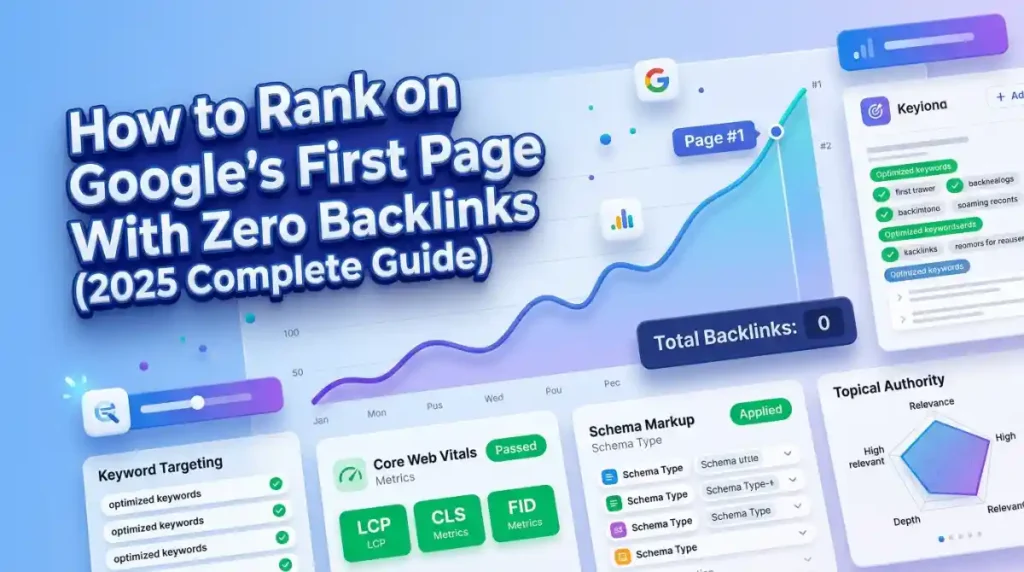
You’ve probably heard it a hundred times: “You need backlinks to rank on Google.” But here’s what most SEO guides won’t tell you — thousands of pages are sitting on Google’s first page right now with zero backlinks pointing to them. And some of them are beating sites that spent thousands on link building.
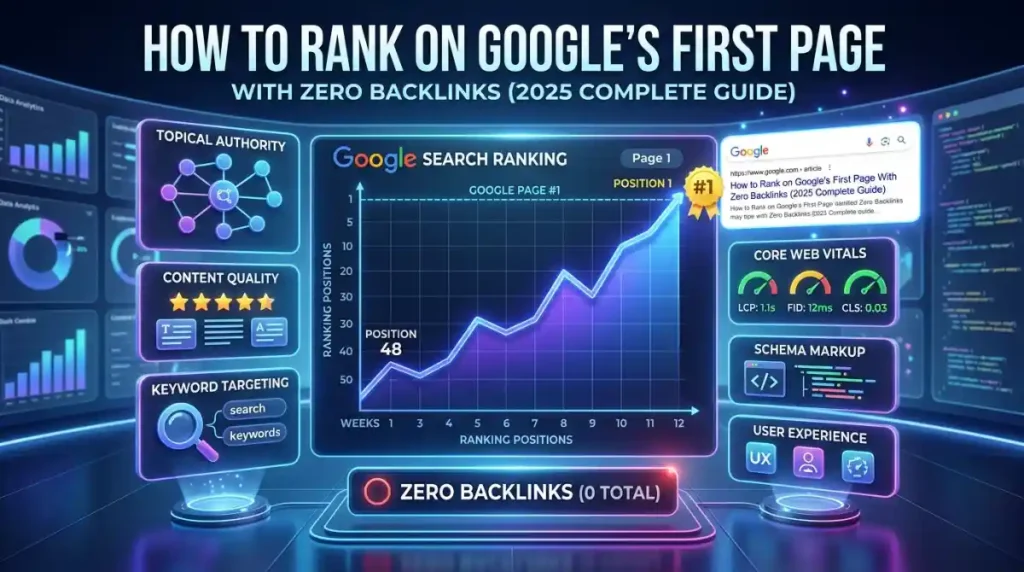
So, can you rank on Google without backlinks? Yes. And this guide shows you exactly how, step by step, using on-page SEO, topical authority, semantic content, and AI overview optimization.
Can you rank on Google’s first page without backlinks?
Yes, you can. Google’s algorithm has evolved far beyond its original PageRank dependency. In 2026, content quality, search intent alignment, E-E-A-T signals, Core Web Vitals, and topical authority carry more ranking power than a pile of mediocre backlinks ever could.
Backlinks still matter for highly competitive, high-volume keywords. But for the vast majority of searches — especially long-tail, informational, and local queries — a single well-written, semantically complete article can absolutely land on page one.
The zero backlink SEO strategy works. You just need to know where to focus.
Why Google doesn’t need backlinks to trust your content anymore
Google’s NLP (natural language processing) systems — particularly BERT and MUM — can now read and understand your content the way a human editor would. It doesn’t just count links. It reads your page and asks: does this fully answer the question? Is this written by someone who actually knows this topic?
When your content passes that test, Google rewards it with visibility — with or without a single external link.
The helpful content system, rolled out and refined through 2024, specifically penalizes content written for algorithms rather than people. And it rewards content that demonstrates real expertise, real experience, and genuine usefulness. That’s E-E-A-T in action: Experience, Expertise, Authoritativeness, and Trustworthiness.
You build those signals through great content, clear structure, and internal authority — not by chasing links.
Step 1: Target the right keywords (low competition is your best friend)
This is where most new sites go wrong. They target keywords like “SEO tips” or “make money online” and wonder why they’re stuck on page 12.
Your zero backlink SEO strategy starts with smart keyword selection. Specifically:
- Long-tail keywords with 3 to 5 words and lower competition
- Informational queries where Google shows blog posts (not paid ads) on page one
- Questions people actually type — “how to rank on Google first page without building backlinks” is far more winnable than “SEO”
Use free tools like Google Search Console, Ubersuggest, or Google’s autocomplete to find keywords where the top results come from mid-authority blogs. That’s your opening.
A useful exercise: type your main keyword into Google and look at “People Also Ask.” Those questions are gold. They tell you exactly what Google thinks users want to know — and each one is a potential subheading in your article.
Want to find and use free SEO and content tools without paying for expensive subscriptions? Check out 25 Best Free AI Tools and Free Online Tools 2026 available at Toolify Worlds.
Step 2: Build topical authority before chasing rankings
Topical authority is what happens when Google sees your site as the go-to source for an entire subject — not just a single article.
Think of it this way: one article on SEO makes you a visitor. Ten interconnected, in-depth articles on SEO make you a resident. Google prefers residents.
Here’s how to build topical authority without backlinks:
- Create a pillar page — one long, comprehensive guide on your main topic (like this article)
- Publish cluster content — 5 to 10 supporting articles that go deeper on subtopics
- Link them all together — internally, using relevant anchor text
So if your pillar is “SEO without backlinks,” your cluster might include articles on on-page SEO techniques, keyword research for beginners, content structure for ranking, and schema markup basics. Each cluster article links back to the pillar. The pillar links out to each cluster.
This content silo strategy tells Google: this site owns this topic. And when Google trusts your topical depth, it ranks your pages — even without external links.
Step 3: Write content that satisfies search intent completely
Search intent is the actual reason someone typed a query. Google’s job is to match queries to content that fully satisfies that intent.
Get this wrong, and no amount of optimization will save you. Get it right, and Google will often reward you fast — even on a new domain.
There are 4 types of search intent:
- Informational — they want to learn something (“how to rank on Google”)
- Navigational — they want to find a specific site (“Ahrefs login”)
- Commercial — they’re comparing options (“best SEO tools 2026”)
- Transactional — they’re ready to act (“buy SEO course”)
For a zero-backlink SEO strategy, informational and commercial queries are your best bets. They reward content quality over link authority.
Before writing, look at the top 5 results for your keyword. What format do they use? (listicle, how-to guide, comparison?) How long are they? What subtopics do they cover? Your article needs to match that format and cover at least everything they cover — preferably more.
Content completeness is a real ranking signal. Thin content that misses key subtopics gets filtered out by Google’s quality systems.
Step 4: Master on-page SEO (this replaces what backlinks used to do)
On-page SEO is your primary tool when you’re not building links. Done right, it can do heavy lifting that most people assume only backlinks can do.
Here’s your on-page SEO checklist for ranking without backlinks:
Title tag: Include your primary keyword near the beginning. Keep it under 60 characters. Make it click-worthy without being clickbait.
Meta description: Write 150 to 160 characters that summarize the article and include a secondary keyword. Google doesn’t use it as a ranking factor, but it affects click-through rate — which does.
H1, H2, H3 hierarchy: Use one H1 with your main keyword. Structure subtopics under H2s. Break down specifics under H3s. This header tag hierarchy tells Google what your article is about and what’s most important.
Keyword placement: Primary keyword in the first 100 words, in at least one H2, and naturally throughout. Don’t stuff. Use it where it reads naturally.
URL structure: Keep it short, descriptive, and keyword-rich. /how-to-rank-without-backlinks beats /blog/post-1234-seo-tips-2026.
Image alt text: Every image needs a descriptive alt tag. This helps Google understand your images and is an easy SEO win most people skip.
Internal links: This is critical. Link to other relevant articles on your site using descriptive anchor text. Internal linking distributes page authority around your site and tells Google which pages matter most.
For a free on-page SEO audit, tools like Ahrefs’ free backlink checker (ahrefs.com) or Semrush’s on-page SEO checker can help you identify gaps before publishing.
Step 5: Use semantic SEO to cover your topic completely
Semantic SEO means writing content that covers not just your target keyword, but the full universe of related concepts, entities, and questions around that topic.
Google’s NLP systems understand that an article about “ranking on Google without backlinks” should also mention topical authority, E-E-A-T, Core Web Vitals, schema markup, and content depth — even if the user didn’t search for those terms.
When your article naturally covers those related concepts, Google sees it as a complete, authoritative resource. And complete resources rank.
Here’s a practical way to do semantic SEO:
- Take your main keyword and brainstorm all the questions someone might have about it
- Include answers to those questions naturally in your article
- Use keyword variations, synonyms, and related terms (LSI keywords) throughout
- Reference authoritative sources like Google’s own documentation, Moz, or Ahrefs where relevant
Semantic content also dramatically improves your chances of appearing in Google’s AI Overview — the AI-generated summary that appears above traditional search results for many queries. To get cited there, your content needs to give clear, structured, direct answers to specific questions.
Step 6: Optimize for Google AI Overview and featured snippets
Google’s AI Overview is the biggest shift in search visibility since featured snippets. Pages cited in AI Overview get massive brand exposure even when users don’t click through.
To rank in AI Overview without backlinks:
- Answer questions directly — put the answer in the first 1 to 2 sentences after the question
- Use structured formats — numbered lists, bullet points, short definitions work well
- Be concise but complete — AI systems extract clean, direct answers, not padded paragraphs
- Use schema markup — FAQPage and Article schema help Google’s AI systems identify and extract your content
A good rule: write every H2 as a question someone might ask Google. Then answer it in 2 to 4 sentences directly below the heading. That structure is ideal for featured snippet eligibility and AI overview citations.
Step 7: Technical SEO — the foundation that makes everything else work
You can write the best article in the world and still not rank if your technical SEO is broken.
The non-negotiables for ranking without backlinks:
Page speed: Google’s Core Web Vitals measure loading speed (LCP), interactivity (INP), and visual stability (CLS). A slow page loses rankings. Use Google PageSpeed Insights (pagespeed.web.dev) to check your scores. Aim for 90+ on mobile.
Mobile-first indexing: Google indexes the mobile version of your site first. If your mobile experience is broken or slow, you’re out — regardless of content quality.
Crawlability: Google can’t rank what it can’t find. Submit an XML sitemap in Google Search Console. Check your robots.txt isn’t blocking important pages. Use breadcrumb navigation to create clear site structure.
HTTPS: Non-secure sites (HTTP) get flagged in Chrome and get lower trust signals from Google. Make sure your SSL certificate is active.
Schema markup: Adding structured data (Article, FAQPage, BreadcrumbList) helps Google understand your content and qualifies you for rich results. This is especially powerful for ranking without backlinks because it builds trust signals directly on your page.
You can validate your schema using Google’s Rich Results Test tool.
Step 8: Build E-E-A-T signals without a single backlink
E-E-A-T (Experience, Expertise, Authoritativeness, Trustworthiness) is Google’s framework for evaluating whether your content deserves to rank. And you can build every single one of these signals without backlinks.
Experience: Write from direct, first-person knowledge. Include real examples, real numbers, things that actually happened. Say “I’ve seen this work on sites with zero domain authority” — not “experts suggest.”
Expertise: Create detailed author bios. Link your authors’ social profiles. Publish content that only someone who actually knows the topic could write. Shallow content written by generalists fails this test.
Authoritativeness: Cover your topic deeply and consistently. A site that publishes 20 articles on SEO looks more authoritative than a site with one SEO article buried among cooking, travel, and finance posts.
Trustworthiness: Add a clear About page, Privacy Policy, Terms and Conditions, and Disclaimer. A site without these looks like it has something to hide. You can find ours at Toolify Worlds Disclaimer and Terms and Conditions.
Entity SEO also falls under trustworthiness. Claim your brand name consistently across the web — Google My Business, social profiles, directories. When Google can identify your brand as a real entity, it trusts your content more.
Step 9: Internal linking strategy (this is your link building)
When you can’t build external backlinks, internal linking is your most powerful alternative.
Internal links do 3 things:
- Pass link equity from strong pages to newer or weaker ones
- Help Google understand the hierarchy and relationship between your pages
- Keep users on your site longer (dwell time is a user engagement signal)
A solid internal linking strategy:
- Link every new article to at least 3 to 5 existing articles on your site
- Link your most important pages from your homepage or navigation
- Use descriptive anchor text (not “click here”) that includes your target keywords
- Update old articles to link to new ones
For example, if you’re writing about free AI tools and you mention content creation, link to Free AI Content Generator Tools or Free AI Tools Better Than ChatGPT. That pass-through of authority is real, and Google uses it.
Step 10: Track, update, and compound your rankings
SEO without backlinks isn’t a one-and-done play. Content freshness is a real ranking signal. Google notices when pages are updated regularly with accurate, current information.
Set a 3-month review cycle for your top articles. Ask: are the facts still current? Are there new subtopics to add? Has the search intent shifted?
Use Google Search Console (free) to track which queries are bringing impressions and clicks. Look for keywords where you’re ranking 5 to 15 — a small content update or structural improvement can push those onto page one.
Also track user engagement signals. If users are landing on your page and bouncing immediately (pogo-sticking back to Google), that tells Google your content didn’t satisfy the query. Fix it. Rewrite the intro. Add a clear answer at the top. Improve page speed.
You don’t need Ahrefs’ paid plan to start. Tools like Reverse Image Search and Stopwatch Timer on Toolify Worlds give you practical utilities alongside your SEO workflow.
Free backlinks you can get while you focus on content
Even though this guide is about ranking without backlinks, there’s nothing wrong with picking up free, easy backlinks while your content does its job.
The best free backlink sources:
- Quora and Reddit — answer questions genuinely and link to your relevant article as a resource
- Google Business Profile — links your site and boosts local SEO without backlinks
- Web 2.0 platforms — Medium, Substack, LinkedIn Articles all allow you to post content with links back to your site
- Forum backlinks — niche forums in your industry often allow profile or signature links
- Blog commenting — leave genuine, valuable comments on relevant blogs with your URL
- Directory submissions — industry directories, local directories, and business listings give dofollow links for free
- Guest posting — pitch a free article to a relevant blog in exchange for an author bio link
- Profile creation backlinks — create profiles on GitHub, Crunchbase, About.me with your site URL
- YouTube description backlinks — publish a video version of your article and link back in the description
These free backlinks from social media and community platforms won’t build massive domain authority overnight. But combined with a strong on-page and semantic SEO foundation, they accelerate your rankings.
How long does it take to rank on Google without backlinks?
For low competition, long-tail keywords: 30 to 90 days with a solid article and proper on-page SEO.
For medium competition keywords: 3 to 6 months with consistent publishing and internal linking.
For high competition, high-volume keywords: you’ll likely need some backlinks to compete at that level.
The honest answer is that zero-backlink ranking works best at the long tail. As you accumulate topical authority through consistent publishing, you’ll start ranking for more competitive terms naturally — because Google begins to trust your domain as a whole.
What is topical authority and how does it help ranking?
Topical authority is Google’s assessment of how comprehensively your site covers a specific subject area.
A site with 1 article on SEO has low topical authority. A site with 50 interconnected, well-written articles covering every aspect of SEO has high topical authority — and Google will rank its content preferentially, even without external backlinks.
Building topical authority means: pick a niche, go deep, be consistent, and link your content together. Domain authority vs topical authority is a real debate in SEO, and the evidence increasingly favors topical authority as the more sustainable ranking signal.
Does internal linking replace backlinks?
Partially, yes. Internal linking can distribute the authority from your strongest pages across your entire site. It can’t replace the external trust signal that a backlink from an authoritative site provides — but for most informational and long-tail queries, a well-internally-linked site with great content will outrank a poorly organized site with mediocre backlinks.
Is on-page SEO enough to rank on Google?
For low to medium competition keywords: yes, absolutely. Combine on-page SEO with semantic content, correct search intent targeting, Core Web Vitals optimization, and topical authority, and you have a complete ranking system that doesn’t require a single external link.
For high competition keywords in saturated niches: you’ll eventually need backlinks too. But you can build significant organic traffic before you ever need to think about link building.
FAQ: Ranking on Google’s first page with zero backlinks
Can a new blog rank on Google without any links? Yes. Target long-tail keywords with low competition, write semantically complete content, optimize your on-page SEO, and build internal links between your articles. New blogs rank on page one every day this way.
What keywords should I target to rank without backlinks? Target long-tail, informational queries with 3 to 5 words. Look for keywords where the top results are from blogs (not Wikipedia or major brand sites) and where the search volume is modest — under 1,000 to 5,000 searches per month is a good starting range.
Does page speed help rank without backlinks? Yes. Core Web Vitals are a confirmed ranking factor. A fast, mobile-friendly page that loads in under 2.5 seconds has a measurable ranking advantage over a slow page — regardless of backlink profile.
How to optimize content for Google AI Overview? Structure your content around direct questions and answers. Use numbered lists and bullet points for step-by-step content. Add FAQPage schema markup. Keep answers concise — 2 to 4 sentences — directly below question-based headings.
What is the fastest way to rank on Google organically? Target low competition long-tail keywords. Write content that fully satisfies search intent. Optimize on-page SEO on day one. Submit your URL to Google Search Console for indexing. Then update the article within 30 days with any gaps you identify.
How do I get on the first page of Google for free? Create high-quality content targeting low-competition keywords. Do thorough on-page SEO. Build topical authority through consistent publishing. Use free tools like Google Search Console, Google’s free keyword research in Search Console, and Toolify Worlds’ Free AI Tools for Content Creators to support your workflow.
Conclusion
Ranking on Google’s first page with zero backlinks is real. It’s repeatable. And it works — especially if you’re starting a new site, a local business blog, or a niche content project without the budget for link building campaigns.
Your actual ranking engine is: the right keyword + complete content + proper on-page SEO + topical authority + technical foundations + internal linking.
Backlinks are a multiplier. But they multiply zero if you don’t have the content foundation in place.
Start there. Build a content cluster around one topic. Optimize every article properly. Link them together. Give Google 60 to 90 days to index and evaluate.
You’ll be surprised what ranks without a single link pointing to it.
Explore free AI tools and SEO utilities — no login required — at Toolify Worlds. And if you want to see what free tools can replace expensive software subscriptions, start with the 25 Best Free AI Tools guide.
Read More Trending topics :
25 best free ai tools
free Online tools 2026
best free tools like Chatgpt
free audio trimmer online
free youtube thumbnil downoader no watermark